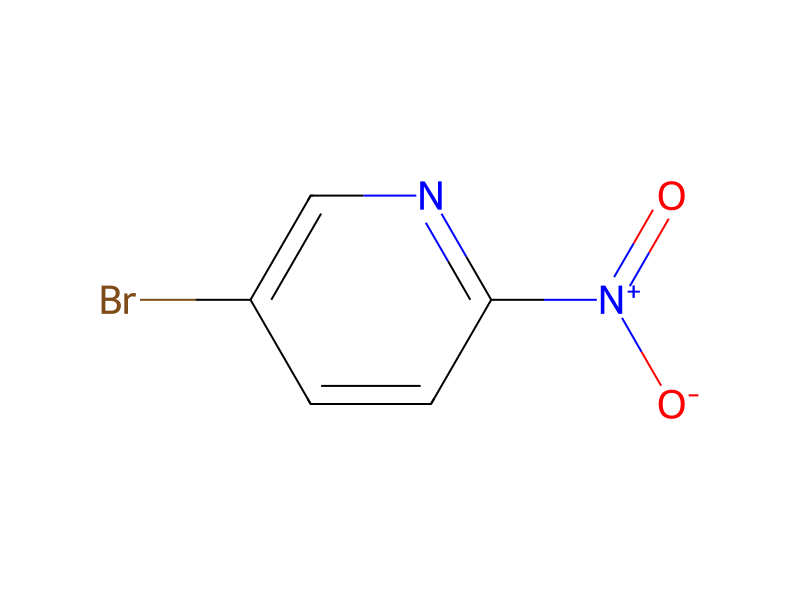
5-Bromo-2-nitropyridine → HCID 67355839, compound
Reaction equation

Br[C:2]1[CH:3]=[CH:4][C:5]([N+:8]([O-:10])=[O:9])=[N:6][CH:7]=1.[C:11]([O:15][C:16]([N:18]1[CH:23]2[CH2:24][CH2:25][CH:19]1[C:20](=[O:26])[NH:21][CH2:22]2)=[O:17])([CH3:14])([CH3:13])[CH3:12]>>[C:11]([O:15][C:16]([N:18]1[CH:23]2[CH2:24][CH2:25][CH:19]1[C:20](=[O:26])[N:21]([C:2]1[CH:7]=[N:6][C:5]([N+:8]([O-:10])=[O:9])=[CH:4][CH:3]=1)[CH2:22]2)=[O:17])([CH3:14])([CH3:12])[CH3:13]Participants
3


Procedure
Following general N—C coupling procedure 1, 5-bromo-2-nitropyridine (110 mg, 0.542), was combined with 2-Oxo-3,8-diaza-bicyclo[3.2.1]octane-8-carboxylic acid tert-butyl ester (135 mg, 0.596 mg), which after purification silica gel chromatography gave 3-(6-Nitro-pyridin-3-yl)-2-oxo-3,8-diaza-bicyclo[3.2.1]octane-8-carboxylic acid tert-butyl ester (290 mg, 81%). MS m/z 349.0 (MH+), and was used directly as is without further characterization.
Workup
- customafter purification silica gel chromatography
Sources & evidence
- ORD record
- ord-45a2cde6055041beb8857881393defdb
- Source dataset
- uspto-grants-2015_02
- Patent number
- US08957074B2
Reaction notes
Loading…