Diisopropylethylamine → Tert-butyl 4-(6-nitropyridin-3-yl)piperazine-1-carboxylate
Reaction equation

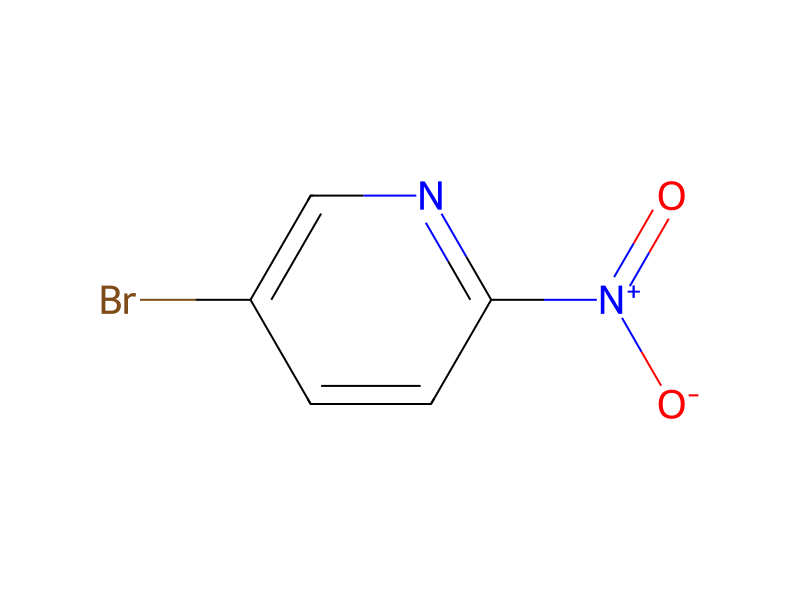
Br[C:2]1[CH:3]=[CH:4][C:5]([N+:8]([O-:10])=[O:9])=[N:6][CH:7]=1.[C:11]([O:15][C:16]([N:18]1[CH2:23][CH2:22][NH:21][CH2:20][CH2:19]1)=[O:17])([CH3:14])([CH3:13])[CH3:12].CCN(C(C)C)C(C)C>CC#N>[C:11]([O:15][C:16]([N:18]1[CH2:23][CH2:22][N:21]([C:2]2[CH:7]=[N:6][C:5]([N+:8]([O-:10])=[O:9])=[CH:4][CH:3]=2)[CH2:20][CH2:19]1)=[O:17])([CH3:14])([CH3:12])[CH3:13]Participants
5




Procedure
To a stirred solution of 5-bromo-2-nitropyridine (4.93 g, 24.3 mmol) and piperazine-1-carboxylic acid tert-butyl ester (4.97 g, 26.7 mmol) in CH3CN (60 ml) is added DIPEA (4.65 mL, 26.7 mmol). The mixture is heated at reflux for 72 hours then cooled to room temperature and the precipitated product collected by filtration. The filtrate is concentrated and purified by flash column chromatography eluting with 30% EtOAc/petrol. The combined products are re-crystallized from EtOAc/petrol to give 4-(6-nitro-pyridin-3-yl)-piperazine-1-carboxylic acid tert-butyl ester, (4.50 g, 80% yield). MS (ESI) m/z 308 (M+H)+
Workup
- temperatureThe mixture is heated
- temperatureat reflux for 72 hours
- filtrationthe precipitated product collected by filtration
- concentrationThe filtrate is concentrated
- custompurified by flash column chromatography
- washeluting with 30% EtOAc/petrol
- customThe combined products are re-crystallized from EtOAc/petrol
Sources & evidence
- ORD record
- ord-49fbf23f606d42a8add8cf4cc7728f36
- Source dataset
- uspto-grants-2015_02
- Patent number
- US08962630B2
Reaction notes
Loading…