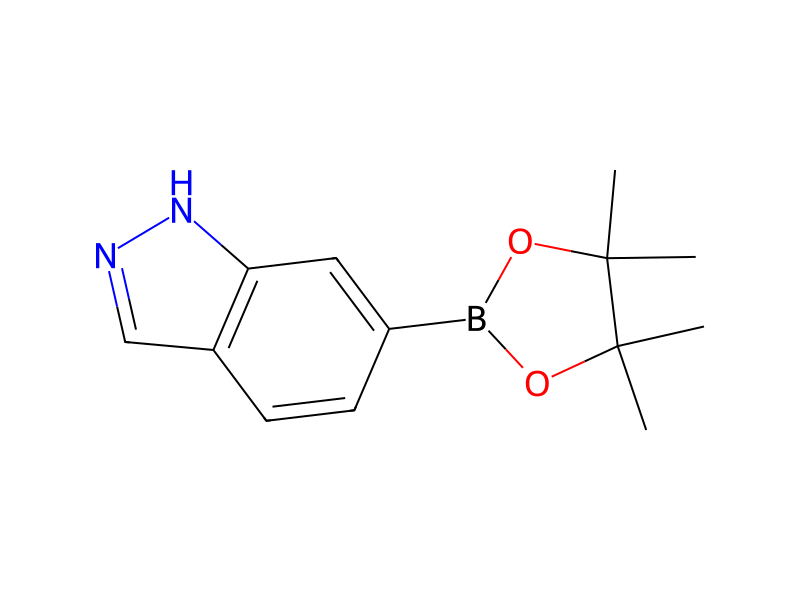
6-(tetramethyl-1,3,2-dioxaborolan-2-yl)-1H-indazole → HCID 67448575, compound
Reaction equation

Br[C:2]1[C:3]2[C:4]3[CH:17]=[CH:16][S:15][C:5]=3[C:6](=[O:14])[NH:7][C:8]=2[CH:9]=[CH:10][C:11]=1[O:12][CH3:13].CC1(C)C(C)(C)OB([C:26]2[CH:34]=[C:33]3[C:29]([CH:30]=[N:31][NH:32]3)=[CH:28][CH:27]=2)O1>>[NH:32]1[C:33]2[C:29](=[CH:28][CH:27]=[C:26]([C:2]3[C:3]4[C:4]5[CH:17]=[CH:16][S:15][C:5]=5[C:6](=[O:14])[NH:7][C:8]=4[CH:9]=[CH:10][C:11]=3[O:12][CH3:13])[CH:34]=2)[CH:30]=[N:31]1Participants
3


Procedure
Following General Procedure B, 9-bromo-8-methoxythieno[2,3-c]quinolin-4(5H)-one (100 mg, 0.32 mmol) was reacted with 6-(4,4,5,5-tetramethyl-1,3,2-dioxaborolan-2-yl)-1H-indazole (120 mg, 0.48 mmol) to afford the desired product (35 mg, 31%) as brown solid: ESI MS m/z 348 [C18H11N3O2S+H]+.
Sources & evidence
- ORD record
- ord-abf369fa0e7348bf883fd44badfef054
- Source dataset
- uspto-grants-2015_02
- Patent number
- US08962648B2
Reaction notes
Loading…