Hydroquinone → 4-(5-Trifluoromethyl-pyridin-2-yloxy)-phenol
Reaction equation

[C:1]1([CH:8]=[CH:7][C:5]([OH:6])=[CH:4][CH:3]=1)[OH:2].Cl[C:10]1[CH:15]=[CH:14][C:13]([C:16]([F:19])([F:18])[F:17])=[CH:12][N:11]=1.[OH-].[K+]>CS(C)=O>[F:17][C:16]([F:19])([F:18])[C:13]1[CH:14]=[CH:15][C:10]([O:2][C:1]2[CH:8]=[CH:7][C:5]([OH:6])=[CH:4][CH:3]=2)=[N:11][CH:12]=1Participants
Reactant 3



Product 1
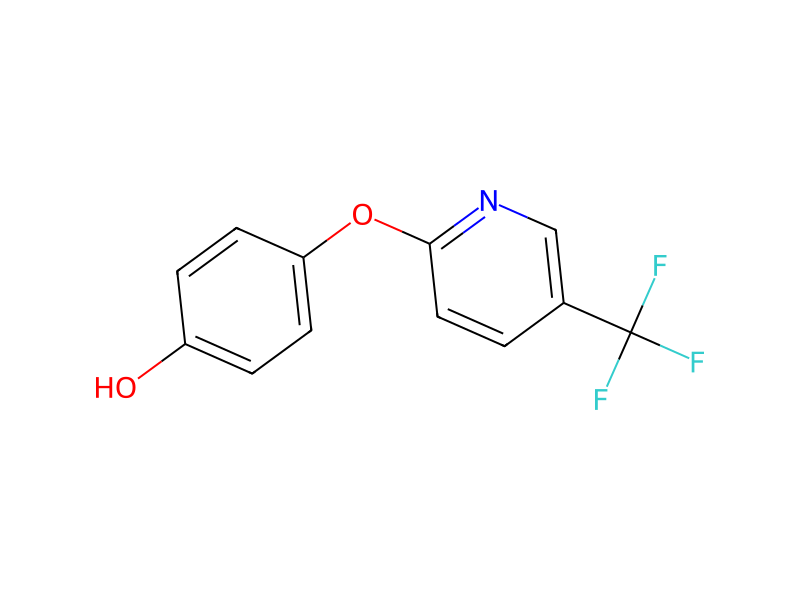
Reagents, catalysts & solvents 1

Conditions
- Temperature
- 150 °C
Procedure
40 ml of dimethyl sulfoxide, 4.2 g of hydroquinone, 5.0 g of 2-chloro-5-trifluoromethylpyridine and 2.3 g of potassium hydroxide were reacted with stirring in a nitrogen gas stream at 150° C. for 2 hours to obtain 2.5 g of 4-(5-trifluoromethyl-2-pyridyloxy)phenol. The thus-obtained 4-(5-trifluoromethyl-2-pyridyloxy)phenol was dissolved in 20 ml of methyl ethyl ketone, and 1.7 g of anhydrous potassium carbonate was added thereto. The mixture was reacted with stirring under reflux for 1 hour, and the reaction product thusobtained was cooled to 40° C., and 2.5 g of ethyl 4-bromo-2-pentenoate was dropwise added thereto gradually. The mixture was allowed to stir for 30 minutes and then to react under reflux for 7 hours. After completion of the reaction, the reaction product was thrown into 100 ml of water, and an oily matter was extracted with methylene chloride. The extracted phase was washed with water several times, and dried over anhydrous sodium sulfate. The solvent was evaporated off to obtain a crude product which was subsequently subjected to silica gel column chromatography using toluene as an eluent to obtain 1.5 g of the object product having a refractive index, nD23, of 1.5145. This was found to have a boiling point of 148°-151° C./l mm Hg with some decomposition.
Sources & evidence
- ORD record
- ord-9533143ed89941cf9babf524cc6f165d
- Source dataset
- uspto-grants-1980_08
- Patent number
- US04216007
Reaction notes
Loading…