Triethylamine → HCID 86737142, compound
Reaction equation

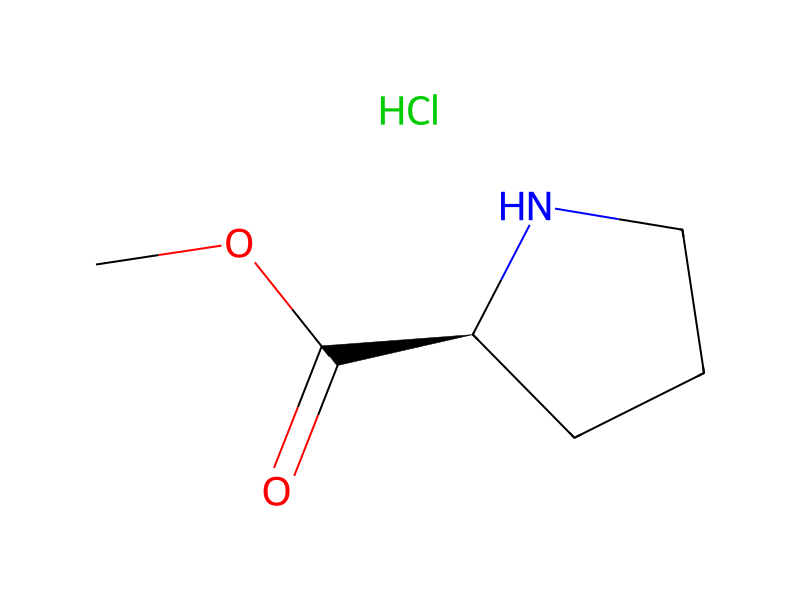
[ClH:1].[CH3:2][O:3][C:4](=[O:10])[C@@H:5]1[CH2:9][CH2:8][CH2:7][NH:6]1.C(N(CC)CC)C.Cl[C:19]1[CH:24]=[CH:23][C:22]([C:25](Cl)=[S:26])=[CH:21][CH:20]=1>C(Cl)(Cl)Cl>[CH3:2][O:3][C:4](=[O:10])[C@@H:5]1[CH2:9][CH:8]([Cl:1])[CH2:7][N:6]1[C:25]([C:22]1[CH:23]=[CH:24][CH:19]=[CH:20][CH:21]=1)=[S:26]Participants
Reactant 3


Product 1

Reagents, catalysts & solvents 1

Procedure
In this example, L-proline methyl ester hydrochloride (16.6 g; 0.1 mole) is dissolved in 100 ml chloroform, and the resulting solution is admixed with triethylamine (13.9 ml; 0.1 mole) under ice cooling (5°-10° C.) for 5 minutes. Then, 4-chlorophenylthiocarbonyl chloride (10.4 g; 0.05 moles) is added in drops at 2°-5° C. for 30 minutes. After stirring for three hours, the reaction solution is washed respectively with about 100 ml water, about 100 ml 2N hydrochloric acid and about 100 ml water, and then dried over anhydrous sodium sulfate (30 g). The solvent is distilled off under reduced pressure, and the resulting crystals are recrystallized from ethyl acetate (about 50 ml) and n-hexane (150 ml), whereby 4-chlorophenylthiocarbonyl-L-proline methyl ester (compound number 22; 18.0 g; m.p.: 90°-91° C.) is obtained. Yield: 60%.
Workup
- washthe reaction solution is washed respectively with about 100 ml water, about 100 ml 2N hydrochloric acid and about 100 ml water
- dry with materialdried over anhydrous sodium sulfate (30 g)
- distillationThe solvent is distilled off under reduced pressure
- customthe resulting crystals are recrystallized from ethyl acetate (about 50 ml) and n-hexane (150 ml)
Sources & evidence
- ORD record
- ord-4f9af0047982445fbab53e2402fec010
- Source dataset
- uspto-grants-1980_08
- Patent number
- US04217130
Reaction notes
Loading…