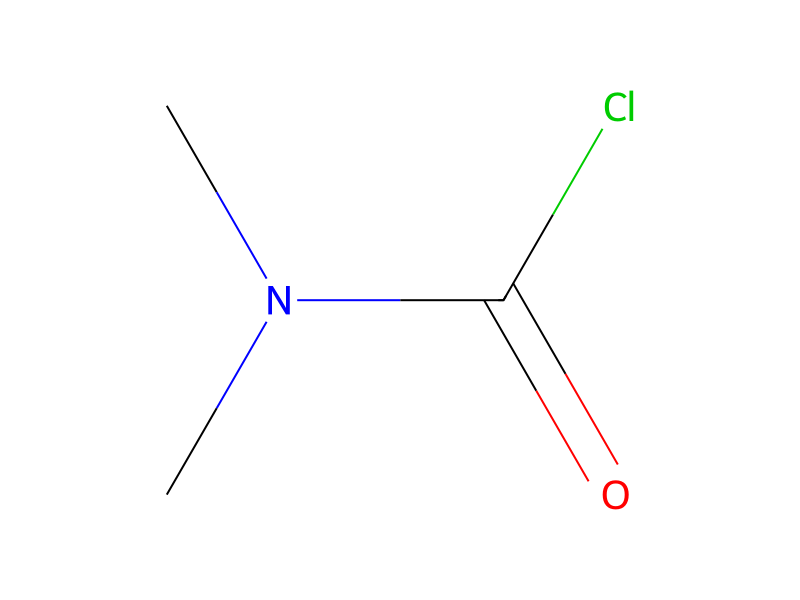
Dimethylcarbamoyl Chloride → HCID 131711849, compound
Reaction equation

[CH3:1][O:2][C:3](=[O:20])[C@@H:4]1[CH2:8][C@@H:7]([OH:9])[CH2:6][N:5]1[C:10]([O:12][CH2:13][C:14]1[CH:19]=[CH:18][CH:17]=[CH:16][CH:15]=1)=[O:11].[CH3:21][N:22]([CH3:26])[C:23](Cl)=[O:24]>C(Cl)(Cl)Cl>[C:10]([N:5]1[CH2:6][C@H:7]([O:9][C:23]([N:22]([CH3:26])[CH3:21])=[O:24])[CH2:8][C@H:4]1[C:3]([O:2][CH3:1])=[O:20])([O:12][CH2:13][C:14]1[CH:19]=[CH:18][CH:17]=[CH:16][CH:15]=1)=[O:11]Participants
4
Reactant 2

Product 1

Reagents, catalysts & solvents 1

Procedure
A solution of N-carbobenzyloxy-trans-4-hydroxy-L-proline methyl ester (Example 1, part b) in chloroform is treated dropwise with an equivalent quantity of dimethylcarbamyl chloride. The mixture is stirred for two hours, washed with water and the organic phase is dried over MgSO4. The solution is filtered and solvent evaporated to give trans-N-carbobenzyloxy-4-[[(dimethylamino)carbonyl]oxy]-L-proline, methyl ester.
Workup
- washwashed with water
- dry with materialthe organic phase is dried over MgSO4
- filtrationThe solution is filtered
- customsolvent evaporated
Sources & evidence
- ORD record
- ord-4ba498f962804c95bfc917e405c5964b
- Source dataset
- uspto-grants-1980_08
- Patent number
- US04217359
Reaction notes
Loading…