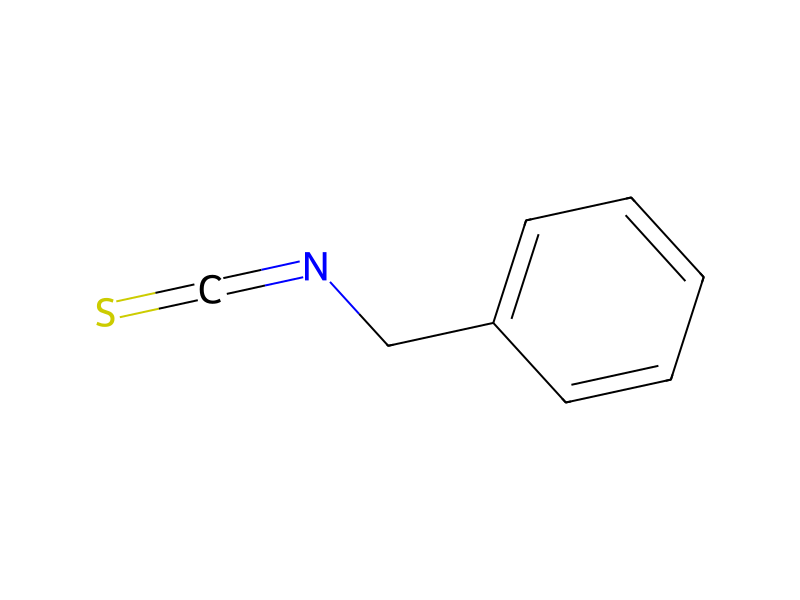
Benzyl Isothiocyanate → HCID 178526718, compound
Reaction equation

C(N=C=S)C1C=CC=CC=1.C(NC(=S)NN)C1C=CC=CC=1.ClC(O[CH2:27][CH3:28])=O.[CH2:29]([N:36]1[C:40]([SH:41])=[N:39][N:38]=[C:37]1[OH:42])[C:30]1[CH:35]=[CH:34][CH:33]=[CH:32][CH:31]=1.Br[C:44]1[S:45][C:46]([N+:49]([O-:51])=[O:50])=CN=1>>[CH2:29]([N:36]1[C:40]([S:41][C:44]2[S:45][C:46]([N+:49]([O-:51])=[O:50])=[CH:27][CH:28]=2)=[N:39][N:38]=[C:37]1[OH:42])[C:30]1[CH:31]=[CH:32][CH:33]=[CH:34][CH:35]=1Participants
6



Procedure
The title compound was prepared in a manner similar to that described in Example 5 starting with benzyl isothiocyanate. The intermediate 4-benzyl-3-thiosemicarbazide (1.81 g) was treated with ethyl chloroformate (1.09 g) as in Example 5. The reaction product 4-benzyl-3-hydroxy-5-mercapto-1,2,4-triazole (1.04 g) was reacted with 1.05 g of 2-bromo-5-nitrothiazole as in Example 5. Crystallization from ethanol and water gave 0.3 g of 4-benzyl-3-hydroxy-5-[(5-nitrothien-2-yl)mercapto]1,2,4-triazole, a yellow solid, MP 221-224° C.
Workup
- customThe title compound was prepared in a manner similar to
- customCrystallization from ethanol and water
Sources & evidence
- ORD record
- ord-69fc8a55d3a843c9b4fcfdf2b056322c
- Source dataset
- uspto-grants-2000_11
- Patent number
- US06143765
Reaction notes
Loading…