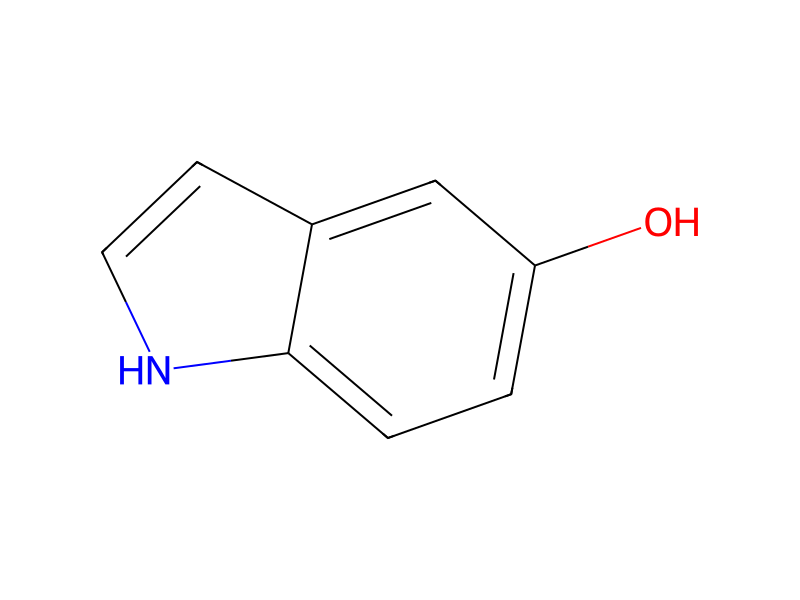
5-Hydroxyindole → 3-(1,2,3,6-Tetrahydropyridin-4-yl)-1H-indol-5-ol
Reaction equation

CC(C)([O-])C.[K+].[OH:7][C:8]1[CH:9]=[C:10]2[C:14](=[CH:15][CH:16]=1)[NH:13][CH:12]=[CH:11]2.C(OC([N:27]1[CH2:32][CH2:31][C:30](=O)[CH2:29][CH2:28]1)=O)C1C=CC=CC=1>C(O)(C)(C)C.C(OCC)(=O)C>[OH:7][C:8]1[CH:9]=[C:10]2[C:14](=[CH:15][CH:16]=1)[NH:13][CH:12]=[C:11]2[C:30]1[CH2:31][CH2:32][NH:27][CH2:28][CH:29]=1Participants
6





Procedure
Potassium tert-butoxide (2.81 g, 25.02 mmol) was added to a solution of 5-hydroxyindole (1.11 g, 8.34 mmol) in tert-butyl alcohol. 1-Benzyloxycarbonyl-4-piperidone (3.89 g, 16.67 mmol) was added to the purple reaction mixture at RT. After 16 h, the reaction mixture was diluted with ethyl acetate (100 ml) and washed with saturated sodium bicarbonate, brine, dried over MgSO4 and concentrated in vacuo. The residue was chromatographed (SiO2, 25-45% ethyl acetate/hexanes) to give 4-(5-hydroxyindol-3-yl)-1,2,3,6-tetrahydropyridine as a white solid (92%).
Workup
- washwashed with saturated sodium bicarbonate, brine
- dry with materialdried over MgSO4
- concentrationconcentrated in vacuo
- customThe residue was chromatographed (SiO2, 25-45% ethyl acetate/hexanes)
Sources & evidence
- ORD record
- ord-755429f28dfe4d1abbb9e556bb3e6063
- Source dataset
- uspto-grants-2000_11
- Patent number
- US06143744
Reaction notes
Loading…