Sodium Iodide → 2-(3-Iodo-propyl)-isoindole-1,3-dione
Reaction equation

[I-:1].[Na+].Br[CH2:4][CH2:5][CH2:6][N:7]1[C:11](=[O:12])[C:10]2=[CH:13][CH:14]=[CH:15][CH:16]=[C:9]2[C:8]1=[O:17]>CC(C)=O>[I:1][CH2:4][CH2:5][CH2:6][N:7]1[C:11](=[O:12])[C:10]2=[CH:13][CH:14]=[CH:15][CH:16]=[C:9]2[C:8]1=[O:17]Participants
4
Reactant 2

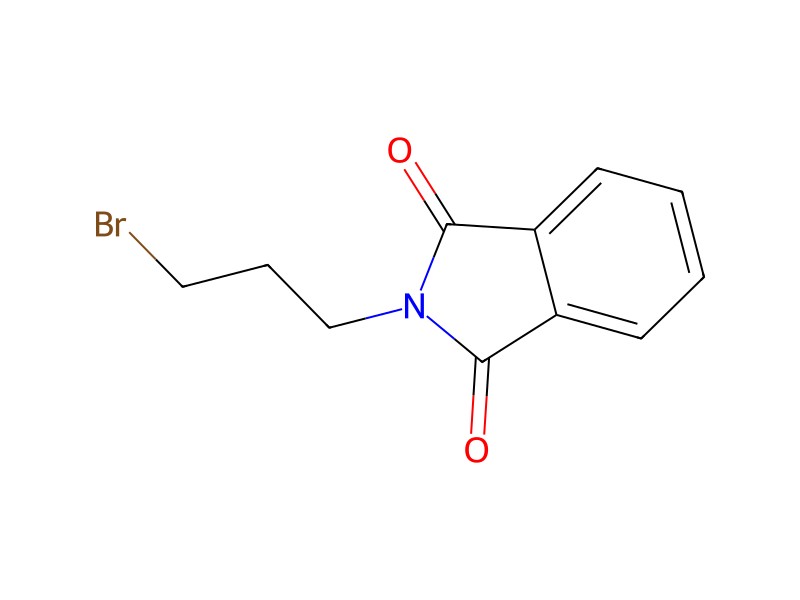
Product 1

Reagents, catalysts & solvents 1

Procedure
To a solution of 15 g (100 mmol) of sodium iodide in 120 ml of acetone was added 3 g (11 mmol) of N-(3-bromopropyl)phthalimide and the mixture was heated at reflux for 30 minutes. The cooled mixture was filtered and evaporated. The residue was partitioned between 50 ml of diethyl ether and 50 ml of water. The organic phase was dried over magnesium sulfate, filtered and evaporated to give 2.6 g (75%) of N-(3-iodopropyl)phthalimide as a white solid. [Mass spectrum (ESI) MH+ =316].
Workup
- temperaturethe mixture was heated
- temperatureat reflux for 30 minutes
- filtrationThe cooled mixture was filtered
- customevaporated
- customThe residue was partitioned between 50 ml of diethyl ether and 50 ml of water
- dry with materialThe organic phase was dried over magnesium sulfate
- filtrationfiltered
- customevaporated
Sources & evidence
- ORD record
- ord-56f9d958bc064da99a8f23292a13192c
- Source dataset
- uspto-grants-2000_11
- Patent number
- US06150373
Reaction notes
Loading…