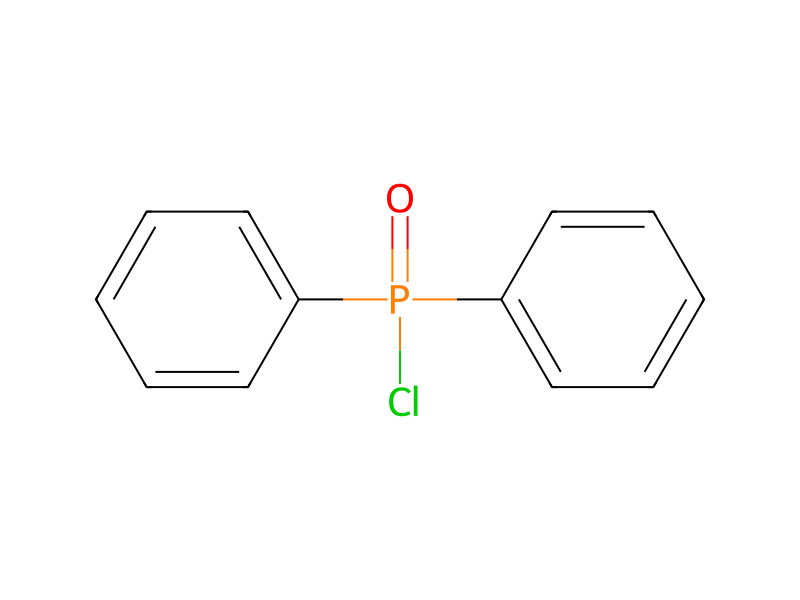
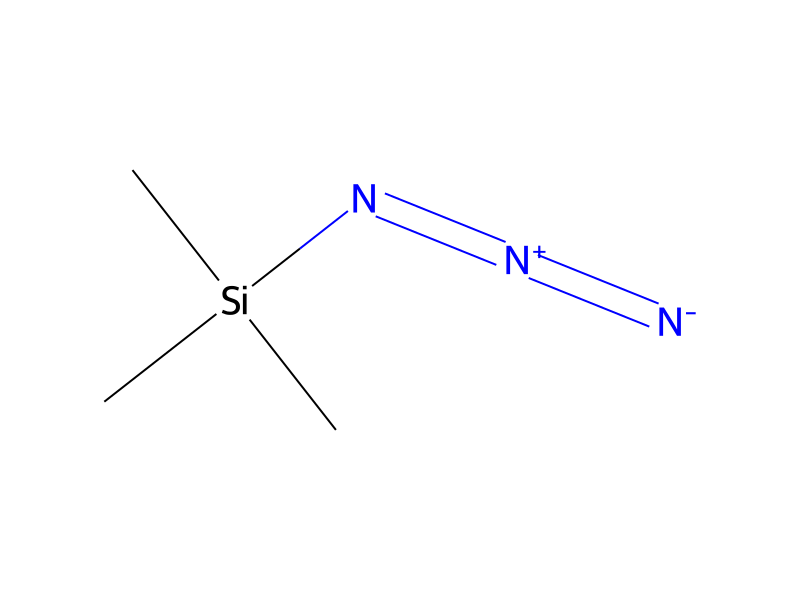
Diphenylphosphinic chloride → P,P-Diphenylphosphinic azide
Reaction equation

[C:1]1([P:7](Cl)([C:9]2[CH:14]=[CH:13][CH:12]=[CH:11][CH:10]=2)=[O:8])[CH:6]=[CH:5][CH:4]=[CH:3][CH:2]=1.C[Si]([N:20]=[N+:21]=[N-:22])(C)C>>[C:1]1([P:7]([N:20]=[N+:21]=[N-:22])([C:9]2[CH:14]=[CH:13][CH:12]=[CH:11][CH:10]=2)=[O:8])[CH:6]=[CH:5][CH:4]=[CH:3][CH:2]=1Participants

Conditions
- Temperature
- 60 °C
Procedure
Following a previously [Paciorek et al, Inorg. Nucl. Chem. Letters, 2, 39 (1966)] developed procedure, diphenylphosphinyl chloride (14.87 g, 62.86 mmol) was introduced into a tube (in the inert atmosphere enclosure). Trimethylsilyl azide (10.45 g, 90.69 mmol) was then condensed onto this material on a vacuum line at liquid nitrogen temperature. The tube was sealed in vacuo and heated at 60° C. for 48 hr. Thereafter, it was cooled, opened to a vacuum system and the volatiles were collected in a liquid nitrogen trap (originally without pumping at room temperature, finally with pumping at 70° C.). The total time required to remove the volatiles (excess (CH3)3SiN3 and the by-product (CH3)3SiCl) was 16 hr. A quantitative yield of pure diphenylphosphinyl azide was realized.
Workup
- additionwas introduced into a tube (in the inert atmosphere enclosure)
- customcondensed onto this material on a vacuum line at liquid nitrogen temperature
- customThe tube was sealed in vacuo
- temperatureThereafter, it was cooled
- customthe volatiles were collected in a liquid nitrogen trap (originally
- customwithout pumping at room temperature
- customwith pumping at 70° C.
- customto remove the volatiles (excess (CH3)3SiN3
Sources & evidence
- ORD record
- ord-72b18d3b314a4b59a5da9634f484da20
- Source dataset
- uspto-grants-1979_09
- Patent number
- US04168287
Reaction notes
Loading…