Diisopropylethylamine → 5-Bromo-6-(4-fluoro-phenyl)-pyrazine-2-carboxylic acid (2-cyclopropyl-2-hydroxy-propyl)-amide
Reaction equation

[Br:1][C:2]1[N:3]=[CH:4][C:5]([C:15]([OH:17])=O)=[N:6][C:7]=1[C:8]1[CH:13]=[CH:12][C:11]([F:14])=[CH:10][CH:9]=1.ClC([N:23](C)C)=C(C)C.NC[CH2:28][C:29]([CH:32]1[CH2:34][CH2:33]1)([OH:31])[CH3:30].C(N(C(C)C)C(C)C)C>ClCCl>[CH:32]1([C:29]([OH:31])([CH3:30])[CH2:28][NH:23][C:15]([C:5]2[CH:4]=[N:3][C:2]([Br:1])=[C:7]([C:8]3[CH:9]=[CH:10][C:11]([F:14])=[CH:12][CH:13]=3)[N:6]=2)=[O:17])[CH2:34][CH2:33]1Participants
Reactant 4

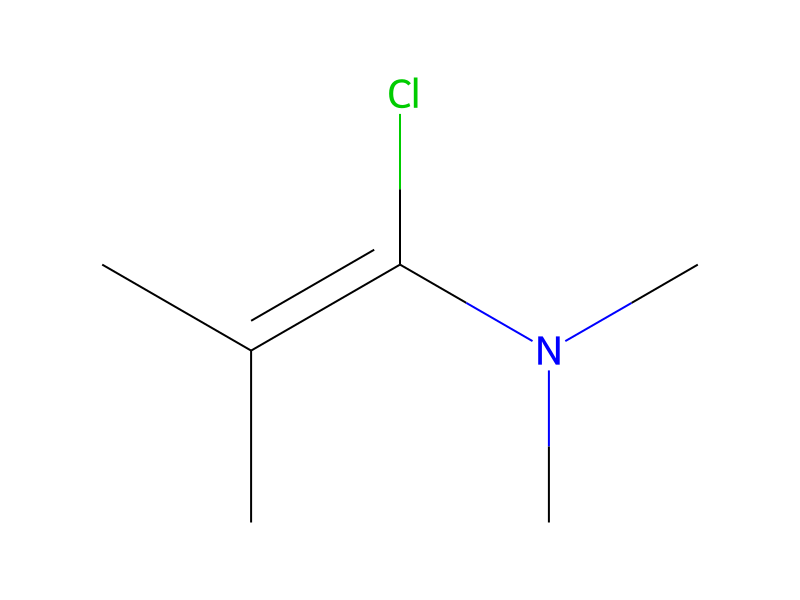


Product 1

Reagents, catalysts & solvents 1

Procedure
To a solution of 0.78 g of 5-bromo-6-(4-fluoro-phenyl)-pyrazine-2-carboxylic acid in 15.0 ml dichloromethane was added at room temperature 0.39 g (1-chloro-2-methyl-propenyl)-dimethyl-amine and the mixture was stirred for 0.5 hours at room temperature. To the resulting white suspension was added 0.333 g 4-amino-2-cyclopropyl-butan-2-ol and 0.45 ml N-ethyldiisopropylamine and the mixture was stirred for 2 hours at room temperature. The resulting mixture was partitioned between 10% aqueous citric acid and dichloromethane. The phases were separated and the organic layer was dried over magnesium sulfate and evaporated. The residue was purified by chromatography on silica gel using a gradient of heptane to 25% ethyl acetate in heptane to yield 0.70 g of the title compound as white crystals. MS (ISP) (M+H+)=394.1 and 396.0.
Workup
- stirringthe mixture was stirred for 2 hours at room temperature
- customThe resulting mixture was partitioned between 10% aqueous citric acid and dichloromethane
- customThe phases were separated
- dry with materialthe organic layer was dried over magnesium sulfate
- customevaporated
- customThe residue was purified by chromatography on silica gel using a gradient of heptane to 25% ethyl acetate in heptane
Sources & evidence
- ORD record
- ord-bd02f1d47f994e9192658472b10f17d3
- Source dataset
- uspto-grants-2009_12
- Patent number
- US07629346B2
Reaction notes
Loading…