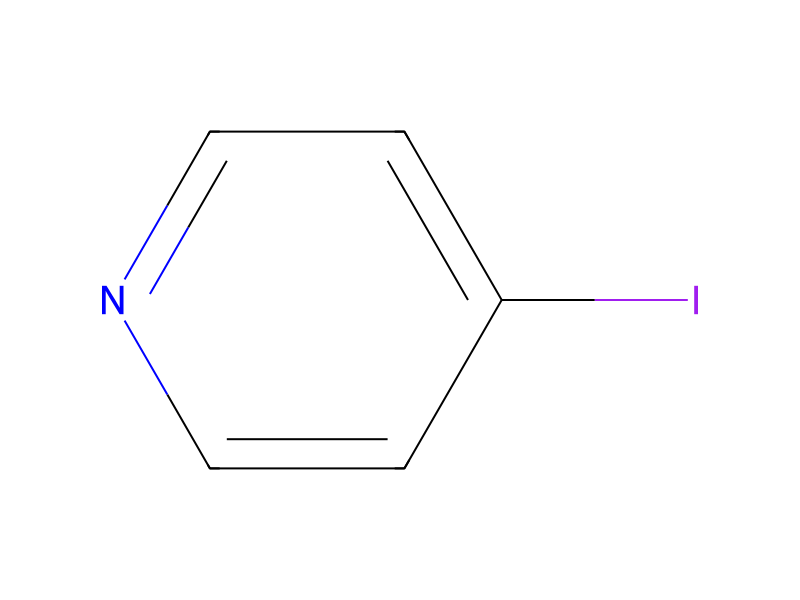
4-Iodopyridine → HCID 57978151, compound
Reaction equation

C([Li])(C)(C)C.I[C:7]1[CH:12]=[CH:11][N:10]=[CH:9][CH:8]=1.[Br:13][C:14]1[CH:15]=[C:16](/[C:20](/[C:28]2[C:29]([C:34]#[N:35])=[N:30][CH:31]=[CH:32][CH:33]=2)=[N:21]\S(C(C)(C)C)=O)[CH:17]=[CH:18][CH:19]=1>C1COCC1>[Br:13][C:14]1[CH:15]=[C:16]([C:20]2([C:7]3[CH:12]=[CH:11][N:10]=[CH:9][CH:8]=3)[C:28]3[C:29](=[N:30][CH:31]=[CH:32][CH:33]=3)[C:34]([NH2:35])=[N:21]2)[CH:17]=[CH:18][CH:19]=1Participants
Reactant 3


Product 1

Reagents, catalysts & solvents 1

Conditions
- Temperature
- -100 °C
Procedure
tert-Butyllithium (1.5 M solution in pentane, 2.15 mL) was diluted with anhydrous THF (10 mL) at −100° C. under an atmosphere of argon. To this was added dropwise a solution of 4-iodopyridine (330 mg, 1.773 mmol) in anhydrous THF (8 ml,), the mixture was stirred at −100° C. for 5 min and then a solution of N-[(1E)-(3-bromophenyl)(2-cyanopyridin-3-yl)methylene]-2-methylpropane-2-sulfinamide (Example 2, 629 mg, 1.612 mmol) in THF (10 mL) was added dropwise while maintaining the temperature at or below −100° C. The mixture was stirred for 1.5 h during which time it was allowed to warm up to −75° C. The reaction was quenched by the addition of water and the mixture was diluted with ethyl acetate. The phases were separated and the aqueous phase was extracted with ethyl acetate. The combined extracts were washed with saturated aqueous sodium hydrogen carbonate and brine, then dried over magnesium sulfate and evaporated. The residue was dissolved in methanol (10 mL) and treated with 2 M hydrochloric acid in diethyl ether overnight at room temperature. The solvents were evaporated and the residue was taken up with saturated aqueous hydrogen carbonate and dichloromethane. The phases were separated, the aqueous phase was extracted with ethyl acetate. The combined organic phases were dried over sodium sulfate and evaporated. Purification by column chromatography using a gradient of increasing concentration of 2 M methanolic ammonia in dichloromethane (from 0 to 5%) gave 406 mg (69% yield) of the title compound. 1H NMR (CDCl3) δ 8.67 (dd, 1H), 8.53 (m, 2H), 7.90 (dd, 1H), 7.41 (m, 3H), 7.23 (m, 3H), 7.18 (m, 1H); MS (ESI) m/z 365, 367 [M+1]+.
Workup
- temperaturewhile maintaining the temperature at or below −100° C
- stirringThe mixture was stirred for 1.5 h during which time it
- temperatureto warm up to −75° C
- customThe reaction was quenched by the addition of water
- additionthe mixture was diluted with ethyl acetate
- customThe phases were separated
- extractionthe aqueous phase was extracted with ethyl acetate
- washThe combined extracts were washed with saturated aqueous sodium hydrogen carbonate and brine
- dry with materialdried over magnesium sulfate
- customevaporated
- dissolutionThe residue was dissolved in methanol (10 mL)
- additiontreated with 2 M hydrochloric acid in diethyl ether overnight at room temperature
- customThe solvents were evaporated
- customThe phases were separated
- extractionthe aqueous phase was extracted with ethyl acetate
- dry with materialThe combined organic phases were dried over sodium sulfate
- customevaporated
- customPurification by column chromatography
- temperatureof increasing concentration of 2 M methanolic ammonia in dichloromethane (from 0 to 5%)
Sources & evidence
- ORD record
- ord-9e018bdc06484c2d9f2beb5f15c11e8f
- Source dataset
- uspto-grants-2009_12
- Patent number
- US07629356B2
Reaction notes
Loading…