Pyrazole → 4-(1H-Pyrazol-1-yl)benzaldehyde
Reaction equation

N1C=CC=CC=1.[CH:7]([C:9]1[CH:14]=[CH:13][C:12](B(O)O)=[CH:11][CH:10]=1)=[O:8].[NH:18]1[CH:22]=[CH:21][CH:20]=[N:19]1>O1CCOCC1.C([O-])(=O)C.[Cu+2].C([O-])(=O)C>[CH:7]([C:9]1[CH:14]=[CH:13][C:12]([N:18]2[CH:22]=[CH:21][CH:20]=[N:19]2)=[CH:11][CH:10]=1)=[O:8]Participants
6
Reactant 3
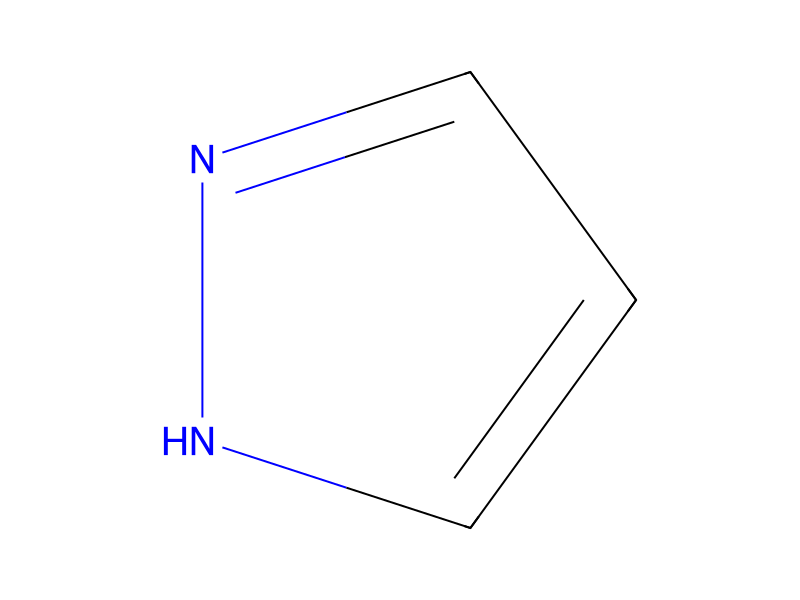


Product 1

Reagents, catalysts & solvents 2


Procedure
Copper acetate (91 mg, 0.5 mmol), pyridine (53 mg, 0.67 mmol) and active Molecular Sieve 4A (250 mg) were added to a solution of 4-formylphenylboronic acid (100 mg, 0.67 mmol) and pyrazole (16 mg, 0.33 mmol) in 1,4-dioxane (4 ml), and they were stirred at room temperature for 72 hours. The reaction mixture was filtered through Celite, and the obtained filtrate was concentrated and then purified by the silica gel TLC chromatography to obtain 1-(4-formylphenyl)pyrazole (yield: 38 mg, 66%) in the form of a white powder.
Workup
- filtrationThe reaction mixture was filtered through Celite
- concentrationthe obtained filtrate was concentrated
- custompurified by the silica gel TLC chromatography
Sources & evidence
- ORD record
- ord-e9a4a07c76424f88a6b0f4fb96006c78
- Source dataset
- uspto-grants-2009_12
- Patent number
- US07632830B2
Reaction notes
Loading…