Water → Boc-gly-pro-OH
Reaction equation

[NH:1]([C:15]([O:17][C:18]([CH3:21])([CH3:20])[CH3:19])=[O:16])[CH2:2][C:3]([O:5]C1C=CC([N+]([O-])=O)=CC=1)=O.[NH:22]1[CH2:29][CH2:28][CH2:27][C@H:23]1[C:24]([OH:26])=[O:25].O>CN(C=O)C>[NH:1]([C:15]([O:17][C:18]([CH3:19])([CH3:20])[CH3:21])=[O:16])[CH2:2][C:3]([N:22]1[CH2:29][CH2:28][CH2:27][C@H:23]1[C:24]([OH:26])=[O:25])=[O:5]Participants
Reactant 3


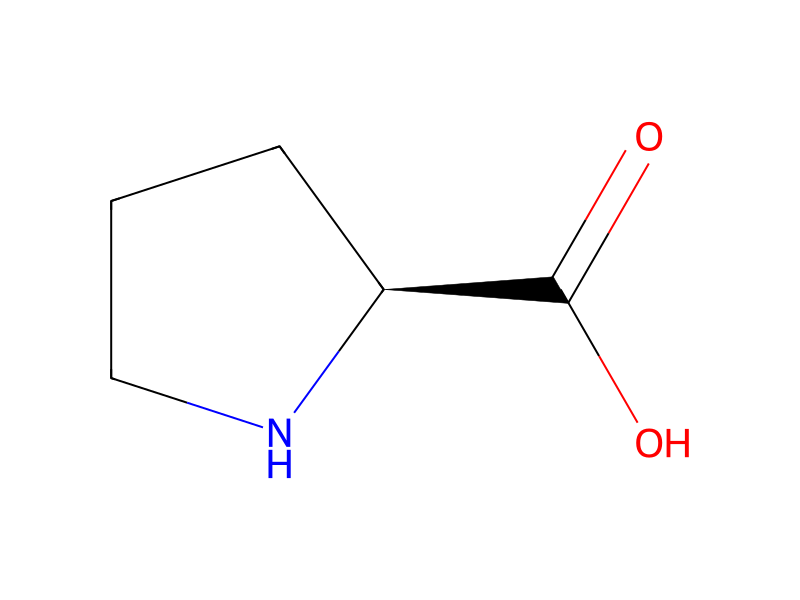
Product 1

Reagents, catalysts & solvents 1

Conditions
- Temperature
- 0 °C
Procedure
Boc-Gly-ONp (50 g, 0.17 mol.) and proline (20.7 g, 0.175 mol.) were dissolved in 300 ml DMF. 20 ml TEA and 30 ml water were added while stirring the solution. The stirring was continued overnight and TLC analysis showed no more starting materials. The solvents were removed under reduced pressure and the resulting mixture was dissolved in 250 ml saturated Na2CO3. The aqueous solution was extracted by 3×100 ml ethyl acetate to remove p-nitrophenol. Then, after chilling to 0° C., the aqueous solution was acidified to about pH=3 by addition of concentrated HCl slowly (vigorously swirling the solution at the same time). The product was extracted from the aqueous phase by 3×150 ml ethyl acetate. The organic phase was combined and washed by saturated NaCl (brine) 3×20 ml, and dried using Na2SO4. TLC analysis showed there was still p-nitrophenol in the solution. The ethyl acetate was removed under reduced pressure and column chromatography (elution solvents: E/H, 2:1) was carried out to obtain the pure product Boc-Gly-Pro-OH (white solid, 41.2 g, 88%). TLC Rf=0.25 (CMA, 85:15:3). FAB-MS, observed (M+H)+ =273. 1H-NMR (360 MHz, DMSO-d6, 20° C.) δ 12.55 (s, 1H, carboxyl), 6.79 (s, NH-major), 6.44 (s, NH-minor), 4.50 (dd, 0.25H, Pro-α-minor), 4.20 (dd, 0.71H, Pro-α-major), 3.81-3.62 (m, 1.7H, Gly-α-major), 3.47-3.33 (m, 2.5H, Pro-δ and Gly-α-minor), 2.25-2.00 (m, 1.2H, Pro-β), 1.96-1.60 (m, 2.7H, Pro-β and Pro-γ), 1.36 (s, 9H, Boc-CH3)b.
Workup
- customThe solvents were removed under reduced pressure
- dissolutionthe resulting mixture was dissolved in 250 ml saturated Na2CO3
- extractionThe aqueous solution was extracted by 3×100 ml ethyl acetate
- customto remove p-nitrophenol
- additionthe aqueous solution was acidified to about pH=3 by addition of concentrated HCl slowly (
- extractionThe product was extracted from the aqueous phase by 3×150 ml ethyl acetate
- washwashed by saturated NaCl (brine) 3×20 ml
- customdried
- customThe ethyl acetate was removed under reduced pressure and column chromatography (elution solvents: E/H, 2:1)
Sources & evidence
- ORD record
- ord-f230a33052dc408f94992154af6f00fb
- Source dataset
- uspto-grants-2000_08
- Patent number
- US06096710
Reaction notes
Loading…