Benzoyl chloride → Benzoyl chloride, 3-bromo-
Reaction equation

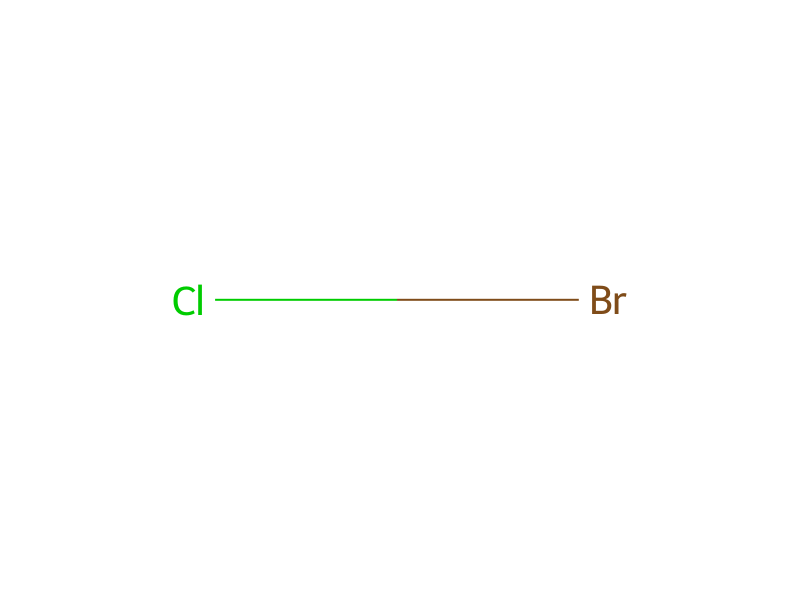
[Br:1]Cl.[C:3]([Cl:11])(=[O:10])[C:4]1[CH:9]=[CH:8][CH:7]=[CH:6][CH:5]=1.BrBr.ClCl>[Fe]>[Br:1][C:6]1[CH:5]=[C:4]([CH:9]=[CH:8][CH:7]=1)[C:3]([Cl:11])=[O:10]Participants
Reactant 4



Product 1

Reagents, catalysts & solvents 1

Procedure
When using bromine chloride as the brominating agent, the bromine chloride can be preformed or formed in situ, and the latter is preferred. In accordance with this preferred procedure, benzoyl chloride, bromine and iron powder are charged to a reactor and the reactor contents are cooled to a temperature in the range of about 0 to about 60° C., preferably about 10° C., and chlorine is slowly fed into the reactor whereby bromine chloride is formed in situ. The bromine chloride reacts with the benzoyl chloride to form m-bromobenzoyl chloride (MBBC). Usually the reaction is performed at a temperature the range of about -10 to about 60° C., preferably at about 10° C. for a period in the range of about 1 to about 24 hours, and typically for about one hour after completion of the chlorine feed. The reaction mixture is then stripped with an inert gas, preferably nitrogen, for 1 to 24 hours at a temperature in the range of about 25 to about 120° C., preferably for two to three hours at about 60 to 90° C., followed by further stripping while cooling to ambient room temperature (ca. 25° C.). During the reaction and subsequent stripping operations, the exit gases are passed through suitable scrubbers to remove purged HCl, and unreacted bromine. The major residual byproducts of the bromination are m-chlorobenzoyl chloride, chlorobromobenzoyl chlorides, and dibromobenzoyl chlorides. The crude MBBC can be purified by distillation at reduced pressure, for example at 160° C. and 60 mm Hg pressure.
Workup
- customformed in situ
- customis formed in situ
Sources & evidence
- ORD record
- ord-4567e094f8e54c86a865dd2eca7c26e8
- Source dataset
- uspto-grants-2000_08
- Patent number
- US06096920
Reaction notes
Loading…