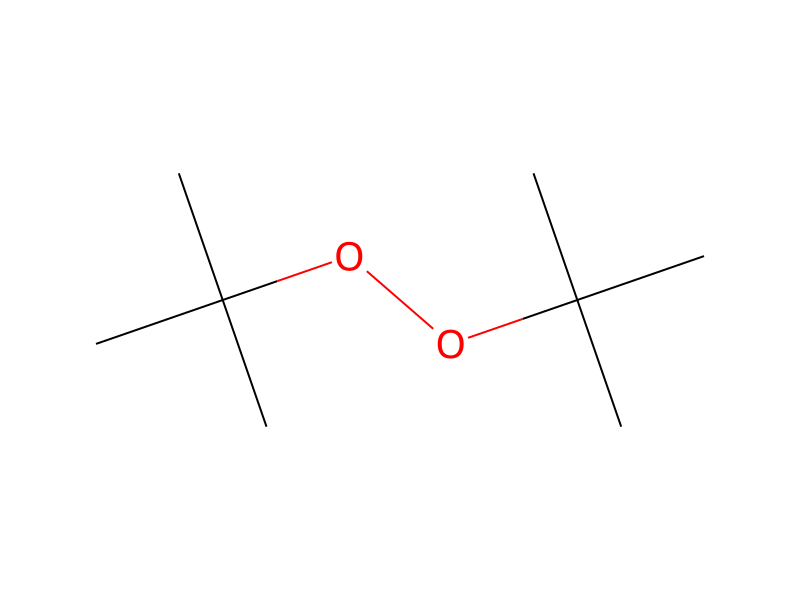
Water → Di-tert-butyl peroxide
Reaction equation

CC1C=C(OCCN2CCN(C)CC2)N([CH2:17][C:18]2[CH:23]=CC=C[CH:19]=2)N=1.[OH2:24]>>[C:18]([O:24][O:24][C:18]([CH3:17])([CH3:19])[CH3:23])([CH3:17])([CH3:19])[CH3:23]Participants


Procedure
As an example it can be mentioned that, with an apparatus including four infrared sources forming an infrared zone having a length of only 300 mm and having a peak value of the wave lengths around 1.2 μm, it has proved possible to produce tubes having a diameter of 15 mm and a wall thickness of 2.5 mm at a speed of 16.5 kg/h. The atmosphere in the oven was nitrogen mixed with air, that is, not an entirely inert atmosphere. The power of the infrared source furthermore was relatively limited. In spite of this the quality of these tubes with regard to dimensional stability, termal stability, surface finish and cross-linking approaches the quality of the tubes obtained with the slow process according to SE-B-324 450, whilst the speed of manufacture approaches the speed of manufacture for the "PEXEP"-method mentioned introductorily. In another example, tubes intended for tap water were manufactured with the same dimensions as the preceding ones with a dispensed mass of 35 kg/h at a melting temperature of about 175° C. and a total applied effect in two IR-zones having each four IR-lamps or 14-15 kW. With an admixture of 0.5% ditert.butylperoxide, cross-linking degrees of between 76 and 78% were obtained, which is well within the range of the desirable degree of cross-linking, 70-90%. The tubes at the same time displayed a very high surface finish both on the inside and on the outside.
Workup
- customforming an infrared zone
- customto produce tubes
- additionmixed with air
- customobtained with the slow process
Sources & evidence
- ORD record
- ord-e612b028d5e749d699d387c2a90f1a26
- Source dataset
- uspto-grants-2000_08
- Patent number
- US06106761
Reaction notes
Loading…