Indole → 3-(8-Aza-bicyclo[3.2.1]oct-2-en-3-yl)-1H-indole
Reaction equation

[NH:1]1[C:9]2[C:4](=[CH:5][CH:6]=[CH:7][CH:8]=2)[CH:3]=[CH:2]1.P(=O)(O)(O)O.[C@@H:15]12[N:22](C)[C@@H:19]([CH2:20][CH2:21]1)[CH2:18][C:17](=O)[CH2:16]2>C(O)(=O)C>[NH:1]1[C:9]2[C:4](=[CH:5][CH:6]=[CH:7][CH:8]=2)[C:3]([C:17]2[CH2:16][CH:15]3[NH:22][CH:19]([CH2:20][CH2:21]3)[CH:18]=2)=[CH:2]1Participants
5
Reactant 3
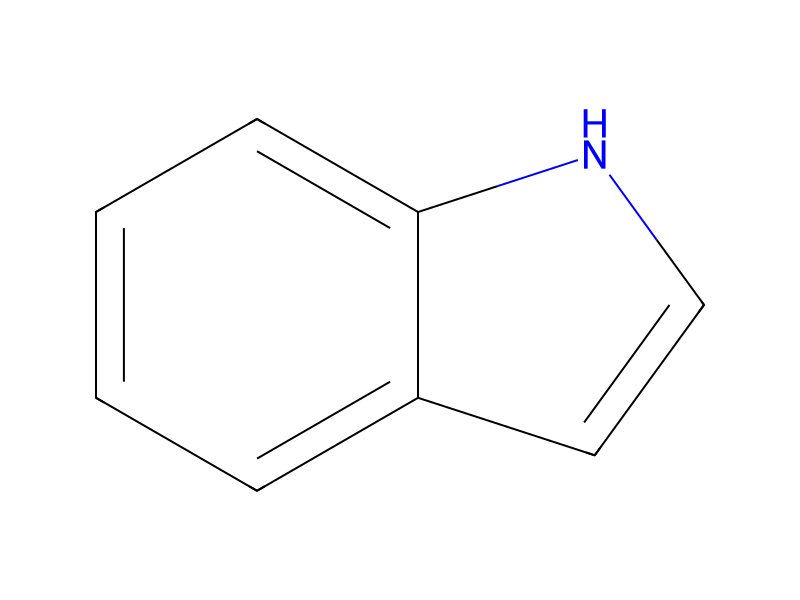


Product 1

Reagents, catalysts & solvents 1

Conditions
- Temperature
- 62.5 °C
Procedure
The reaction is performed by first dissolving the indole in a suitable solvent, typically acetic acid, and then adding a suitable acid, such as hydrochloric or phosphoric acid. The 3-tropanone is then added and the reaction heated at about 60-65° C. for from about 4 to about 24 hours. The resulting 3-(indol-3-yl)-8-azabicyclo-[3.2.1]oct-2-ene is isolated by pouring the reaction mixture into an ice water slurry, adjusting the pH of the aqueous mixture to about 8 by the addition of base, typically sodium hydroxide, and extracting with a water immiscible solvent, typically dichloromethane or ethyl acetate. The product recovered may be purified by crystallization or chromato-graphy as necessary or desired.
Workup
- additionadding a suitable acid
Sources & evidence
- ORD record
- ord-289205c8c9d04e76b8a3247b7469f177
- Source dataset
- uspto-grants-2000_08
- Patent number
- US06107307
Reaction notes
Loading…