Acryloyl chloride → Hexafluoroisopropyl acrylate
Reaction equation

[C:1](Cl)(=[O:4])[CH:2]=[CH2:3].[F:6][C:7]([F:15])([F:14])[CH:8]([OH:13])[C:9]([F:12])([F:11])[F:10].C(C1C=C(C)C=C(C(C)(C)C)C=1O)(C)(C)C.OS(O)(=O)=O.O=S(=O)=O>>[C:1]([O:13][CH:8]([C:9]([F:12])([F:11])[F:10])[C:7]([F:15])([F:14])[F:6])(=[O:4])[CH:2]=[CH2:3]Participants


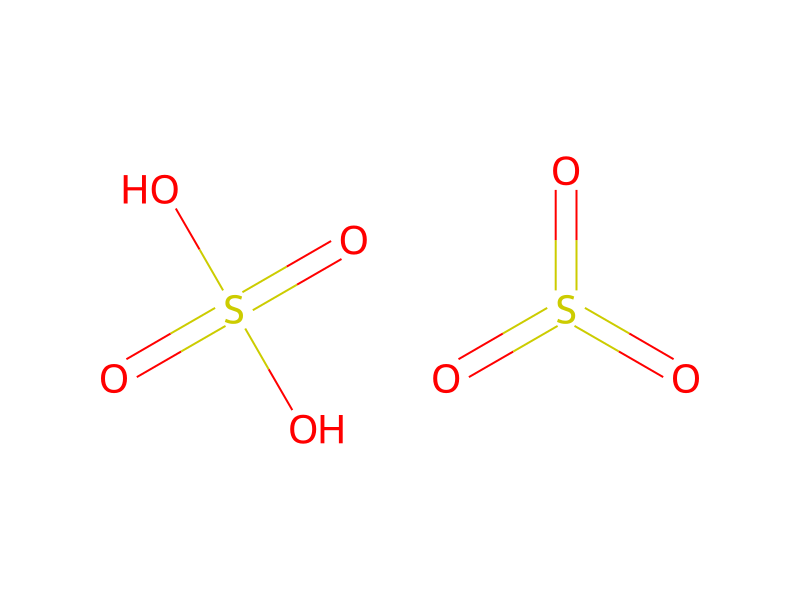


Procedure
With reference to scheme (13) above, a 1000 mL three-neck flask can be equipped with a thermometer, agitator, and dropping funnel with a dip tube. Into the flask can be added about 130.6 grams of acryloyl chloride, 168.8 grams 1,1,1,3,3,3-hexafluoropropan-2-ol, and 1 grain of 2,6-di-tert-butyl-4-methylphenol to form a mixture. About 30% (wt/wt) oleum can then be added to the mixture through the dip tube while maintaining the mixture at 60° C.-75° C. After addition, the mixture can be maintained at 60° C.-70° C. for about 4 hours. Single stage vacuum distillation of the mixture can yield about 183 grains of crude product 1,1,1,3,3,3-hexafluoropropan-2-yl acrylate being about 95.7% (area percent by as chromatography). The crude 1,1,1,3,3,3-hexafluoropropan-2-yl can be distilled further to increase purity to 99.7% (area percent by gas chromatography).
Workup
- customWith reference to scheme (13) above, a 1000 mL three-neck flask can be equipped with a thermometer, agitator
- customto form a mixture
- temperaturewhile maintaining the mixture at 60° C.-75° C
- additionAfter addition
- temperaturethe mixture can be maintained at 60° C.-70° C. for about 4 hours
- distillationSingle stage vacuum distillation of the mixture
Sources & evidence
- ORD record
- ord-6832a404f5f44c3bbfdd9241e5606f73
- Source dataset
- uspto-grants-2012_11
- Patent number
- US08318656B2
Reaction notes
Loading…