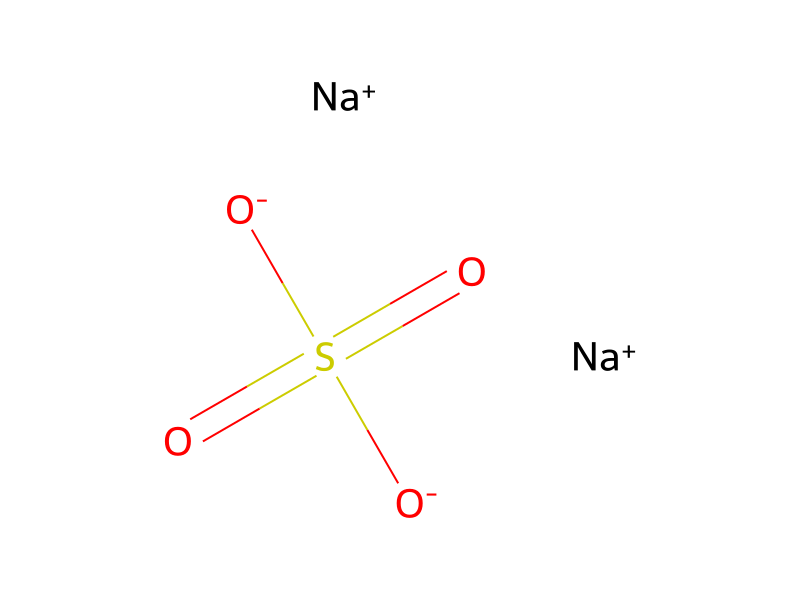
Sodium Sulfate → HCID 23509656, compound
Reaction equation

[CH:1]([NH:4][C:5]1[CH:12]=[CH:11][CH:10]=[C:9]([C:13]2[CH:18]=[CH:17][CH:16]=[CH:15][CH:14]=2)[C:6]=1[C:7]#[N:8])([CH3:3])[CH3:2].[H-].[Al+3].[Li+].[H-].[H-].[H-].S([O-])([O-])(=O)=O.[Na+].[Na+]>O1CCCC1>[CH:1]([NH:4][C:5]1[CH:12]=[CH:11][CH:10]=[C:9]([C:13]2[CH:18]=[CH:17][CH:16]=[CH:15][CH:14]=2)[C:6]=1[CH2:7][NH2:8])([CH3:3])[CH3:2]Participants
Reactant 3


Product 1

Reagents, catalysts & solvents 1

Procedure
The product of example 2a above, 2-isopropylamino-6-phenylbenzonitrile, (0.095 g, 0.4 mmol) was dissolved in dry tetrahydrofuran (20 mL) and stirred under argon at room temperature. Lithium aluminum hydride (0.160 g, 4 mmol) was added and the mixture heated to reflux under argon for 16 hours. The reaction mixture was cooled to room temperature and anhydrous sodium sulfate was added followed by the addition of a freshly prepared saturated solution of anhydrous sodium sulfate. The solvent was evaporated and the residue triturated with ethyl acetate, filtered and evaporated. Flash chromatography on silica gel eluted with 0-3% methanol in methylene chloride followed by recrystallization from ethyl acetate/hexane gave the title compound as a white crystalline solid. ES (+) MS m/e=241 (MH+)
Workup
- temperaturethe mixture heated
- temperatureto reflux under argon for 16 hours
- temperatureThe reaction mixture was cooled to room temperature
- customThe solvent was evaporated
- customthe residue triturated with ethyl acetate
- filtrationfiltered
- customevaporated
- washFlash chromatography on silica gel eluted with 0-3% methanol in methylene chloride
- customfollowed by recrystallization from ethyl acetate/hexane
Sources & evidence
- ORD record
- ord-39333135cd214cd3ae22bb428c468b84
- Source dataset
- uspto-grants-2004_07
- Patent number
- US06759410B1
Reaction notes
Loading…