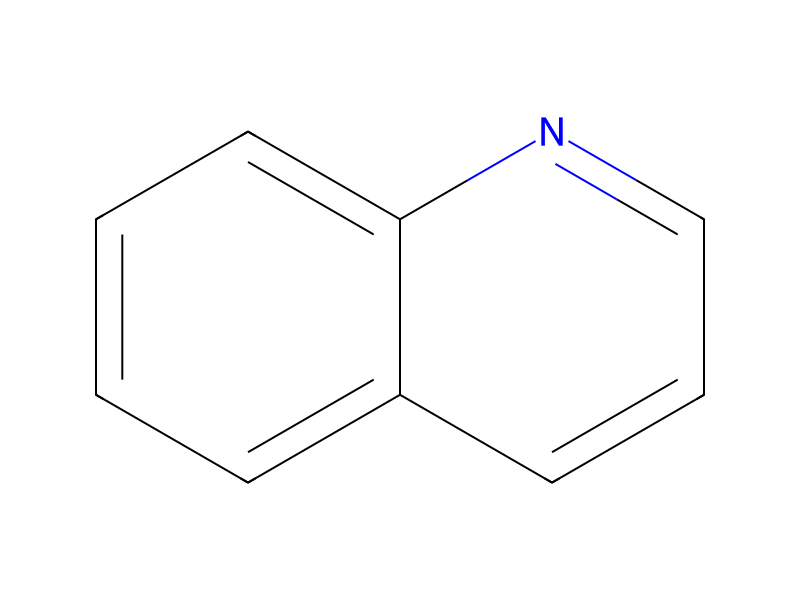
Quinoline → 2,4-Diisopropylphenol
Reaction equation

[CH:1]([C:4]1[CH:12]=[C:11]([CH:13]([CH3:15])[CH3:14])[CH:10]=[C:6](C(O)=O)[C:5]=1[OH:16])([CH3:3])[CH3:2].N1C2C(=CC=CC=2)C=CC=1>CCOC(C)=O>[CH:1]([C:4]1[CH:12]=[C:11]([CH:13]([CH3:15])[CH3:14])[CH:10]=[CH:6][C:5]=1[OH:16])([CH3:3])[CH3:2]Participants
4
Reactant 2

Product 1

Reagents, catalysts & solvents 1

Procedure
A mixture of 3,5-diisopropylsalicylic acid (Intermediate 9, 25 g, 0.11 mol, available from Aldrich) and quinoline (50 mL) was refluxed for 4 h. The mixture was cooled to room temperature, diluted with EtOAc (200 mL), washed with 1M HCl (2×200 mL) until acidic, then with brine, dried over Na2SO4, and concentrated in vacuo. The residue was purified by flash column chromatography on silica gel (5% then 10% EtOAc-hexanes) to yield the title compound as a yellow oil (20 g, ˜100%).
Workup
- temperaturewas refluxed for 4 h
- washwashed with 1M HCl (2×200 mL) until acidic, then with brine
- dry with materialdried over Na2SO4
- concentrationconcentrated in vacuo
- customThe residue was purified by flash column chromatography on silica gel (5%
Sources & evidence
- ORD record
- ord-c0ee3cf0b56346188347ffa2d8b796d3
- Source dataset
- uspto-grants-2004_07
- Patent number
- US06759546B1
Reaction notes
Loading…