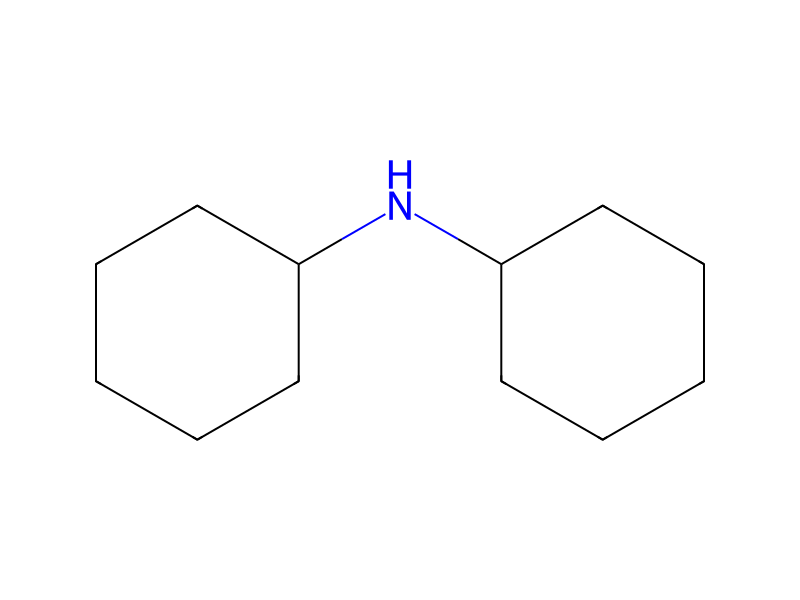
Dicyclohexylamine → Dichloro(dicyclohexylamino)phosphine
Reaction equation

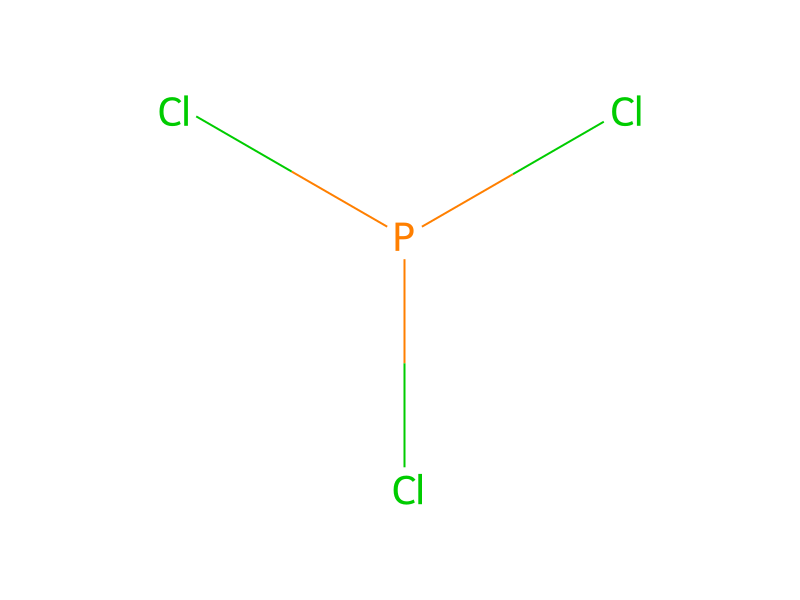
[P:1]([Cl:4])(Cl)[Cl:2].[NH:5]([CH:12]1[CH2:17][CH2:16][CH2:15][CH2:14][CH2:13]1)[CH:6]1[CH2:11][CH2:10][CH2:9][CH2:8][CH2:7]1.N(C1CCCCC1)C1CCCCC1.Cl>CCCCCC>[N:5]([P:1]([Cl:4])[Cl:2])([CH:12]1[CH2:13][CH2:14][CH2:15][CH2:16][CH2:17]1)[CH:6]1[CH2:11][CH2:10][CH2:9][CH2:8][CH2:7]1Participants
5
Reactant 3

Product 1

Reagents, catalysts & solvents 1

Procedure
A mixture of 34.4 g (0.25 moles) of PCl3 in 400 mL of hexane was treated with Cy2NH (90.7 g, 0.50 moles) dropwise at ° C. for 30 min. The resulting white slurry was warmed to room temperature and stirred for 1 h, refluxed overnight before removal of Cy2NH—HCl by filtration. The white solids were washed with hexane (2×100 mL). The combined filtrates were concentrated to give the crude Cy2N—PCl2 (54.0 g, 77% yield). 31P NMR (121 MHz, CD2Cl2): δ171.3 (s) ppm.
Workup
- washThe white solids were washed with hexane (2×100 mL)
- concentrationThe combined filtrates were concentrated
Sources & evidence
- ORD record
- ord-6c60c341c08048fa87766dce1af6d968
- Source dataset
- uspto-grants-2004_07
- Patent number
- US06762330B2
Reaction notes
Loading…