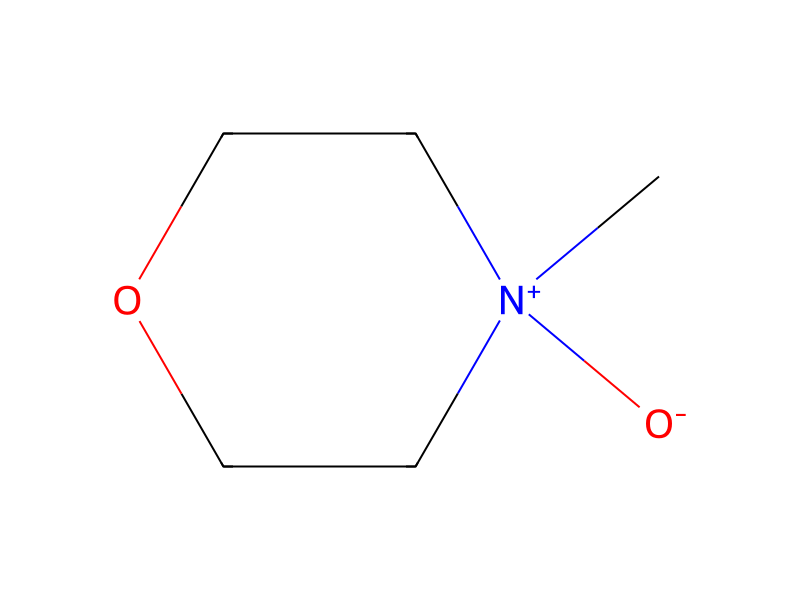
Methyl morpholine oxide → (4R)-(+)-t-Butyldimethylsiloxy-2-cyclopenten-1-one
Reaction equation

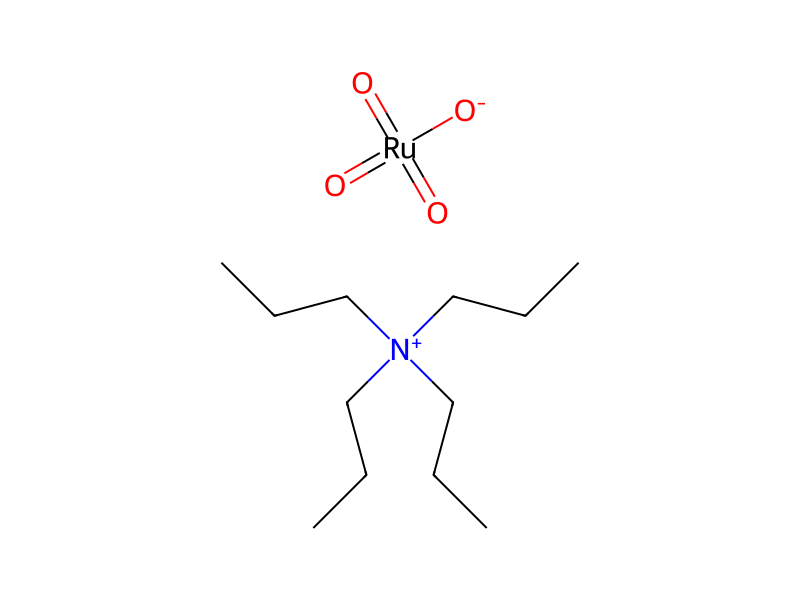
[Si:1]([O:8][C@@H:9]1[CH2:13][C@H:12]([OH:14])[CH:11]=[CH:10]1)([C:4]([CH3:7])([CH3:6])[CH3:5])([CH3:3])[CH3:2].C[N+]1([O-])CCOCC1>C(Cl)Cl.[Ru]([O-])(=O)(=O)=O.C([N+](CCC)(CCC)CCC)CC>[Si:1]([O:8][C@@H:9]1[CH2:13][C:12](=[O:14])[CH:11]=[CH:10]1)([C:4]([CH3:7])([CH3:6])[CH3:5])([CH3:3])[CH3:2]Participants
5
Reactant 2

Product 1

Reagents, catalysts & solvents 2

Procedure
Tetrapropylammonium perruthenate (9.4 mg, 0.027 mmol) was added to a mixture of (1S, 4R)-4-(tert-butyldimethylsilanyloxy)cyclopent-2-enol prepared, according to Tetrahedron Letters, Vol. 37, No. 18, 1996, pp. 3083-6, (118.6 mg, 0.54 mmol), 4-methylmorpholine N-oxide (94.9 mg, 0.81 mmol) and crushed 4 Å sieves (270 mg) in CH2Cl2 (10 mL). The mixture was stirred for 30 min and was passed through a plug of silica gel with CH2Cl2. The filtrate was concentrated in vacuo to give 100 mg (86%) of the above titled compound.
Workup
- customprepared
- concentrationThe filtrate was concentrated in vacuo
Sources & evidence
- ORD record
- ord-bcebf6360aba4fd8958bc2ba2609660a
- Source dataset
- uspto-grants-2004_07
- Patent number
- US06767920B2
Reaction notes
Loading…