Pyridine → 4-Chloro-N'-(diphenylmethylene)pentane hydrazide
Reaction equation

[Cl:1][CH:2]([CH3:8])[CH2:3][CH2:4][C:5](Cl)=[O:6].[C:9]1([C:15]([C:18]2[CH:23]=[CH:22][CH:21]=[CH:20][CH:19]=2)=[N:16][NH2:17])[CH:14]=[CH:13][CH:12]=[CH:11][CH:10]=1.N1C=CC=CC=1.C(OCC)(=O)C>ClCCl>[Cl:1][CH:2]([CH3:8])[CH2:3][CH2:4][C:5]([NH:17][N:16]=[C:15]([C:9]1[CH:14]=[CH:13][CH:12]=[CH:11][CH:10]=1)[C:18]1[CH:23]=[CH:22][CH:21]=[CH:20][CH:19]=1)=[O:6]Participants


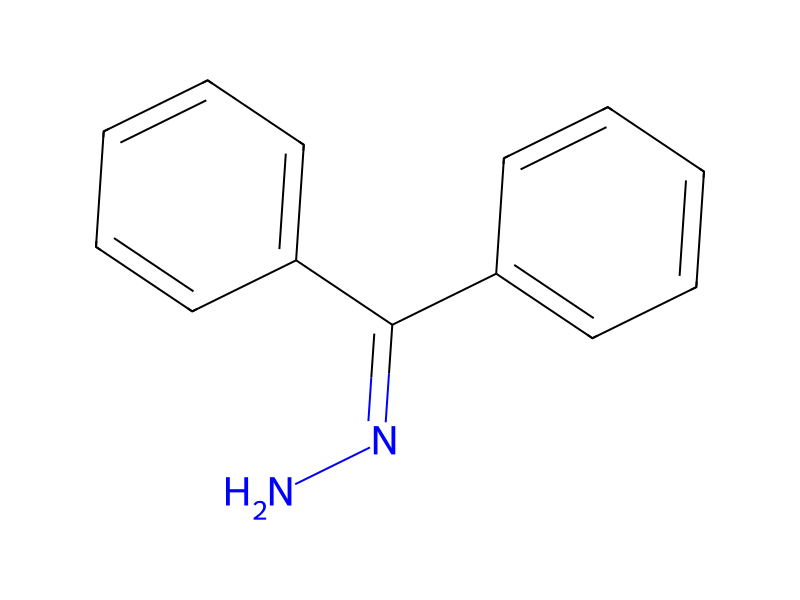



Procedure
At 0° C., a solution of 0.16 g (1.0 mmol) of 4-chloropentanoyl chloride in 15 ml dichloromethane is added to a solution of 0.20 g (1.0 mmol) of diphenylmethanone hydrazone and 0.08 ml of pyridine in 15 ml of dichloromethane. The reaction mixture is stirred at room temperature for 16 h. Ethyl acetate/saturated aqueous NH4Cl solution is added to the reaction mixture, the organic phase is separated off and the aqueous phase is extracted with 3×100 ml of ethyl acetate. The combined organic phases are dried over Na2SO4 and freed from the solvent under reduced pressure. Purification by column chromatography on silica gel (cyclohexane/ethyl acetate) gives 0.32 g (100%) of the desired product; log P(HCOOH): 3.76; 1H-NMR (ppm): δ (DMSO-d6)=1.45 (d, 0.9H), 1.52 (d, 2.1H), 1.81-2.12 (m, 1H), 2.30-2.42 (m, 1H), 2.88-3.00 (m, 2H), 4.13-4.20 (m, 0.3H), 4.28-4.34 (m, 0.7H), 7.26-7.61 (m, 10H), 9.19 (s, 1H); LC-MS: m/z=315 [M+H]+
Workup
- customthe organic phase is separated off
- extractionthe aqueous phase is extracted with 3×100 ml of ethyl acetate
- dry with materialThe combined organic phases are dried over Na2SO4
- customPurification by column chromatography on silica gel (cyclohexane/ethyl acetate)
Sources & evidence
- ORD record
- ord-e59eee7ba3ae4894a256bc10bde5449c
- Source dataset
- uspto-grants-2013_08
- Patent number
- US08507472B2
Reaction notes
Loading…