2-(Trifluoromethoxy)aniline → HCID 86655255, compound
Reaction equation

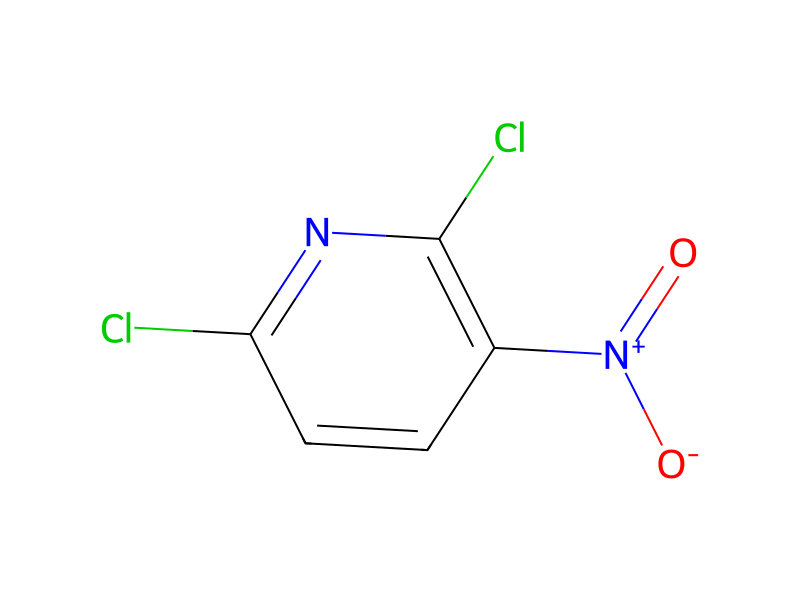
Cl[C:2]1[C:7]([N+:8]([O-:10])=[O:9])=[CH:6][CH:5]=[C:4]([Cl:11])[N:3]=1.[F:12][C:13]([F:23])([F:22])[O:14][C:15]1[CH:21]=[CH:20][CH:19]=[CH:18][C:16]=1[NH2:17]>C(O)C>[Cl:11][C:4]1[N:3]=[C:2]([NH:17][C:16]2[CH:18]=[CH:19][CH:20]=[CH:21][C:15]=2[O:14][C:13]([F:12])([F:22])[F:23])[C:7]([N+:8]([O-:10])=[O:9])=[CH:6][CH:5]=1Participants
Reactant 2

Product 1

Reagents, catalysts & solvents 1

Conditions
- Temperature
- 100 °C
Procedure
2,6-Dichloro-3-nitropyridine (10.0 g, 51.8 mmol) and 2-(trifluoromethoxy)aniline (18.4 g, 104 mmol) were taken up in ethanol (50 mL) and heated to 100° C. for 48 h in a sealed tube. The reaction mixture was cooled in an ice bath, and the resulting precipitate was collected by vacuum filtration to give an intermediate 6-chloro-3-nitro-N-(2-(trifluoromethoxy)phenyl)pyridin-2-amine, which was dissolved in dioxane (65 mL) and H2O (35 mL). Potassium hydroxide (2.90 g, 51.7 mmol) was added and the reaction mixture was heated to 100° C. for 16 h. After cooling, the pH was adjusted to less than 7 with 1 N HCl. The resulting precipitate was collected by vacuum filtration to give the title compound as a bright yellow solid (5.10 g). LCMS m/z=316.0 [M+H]+; 1H NMR (400 MHz, CDCl3) δ ppm 5.91 (d, J=10.1 Hz, 1H), 7.51 (m, 4H), 8.26 (d, J=10.1 Hz, 1H), 8.50-8.85 (broad s, 1H), 10.78 (broad s, 1H).
Workup
- temperatureThe reaction mixture was cooled in an ice bath
- filtrationthe resulting precipitate was collected by vacuum filtration
Sources & evidence
- ORD record
- ord-1db2c1eea677473cb4c24094fb69e5ab
- Source dataset
- uspto-grants-2013_08
- Patent number
- US08507473B2
Reaction notes
Loading…