Triphenylphosphine → [(3-Carboxyphenyl)methyl](triphenyl)phosphanium bromide
Reaction equation
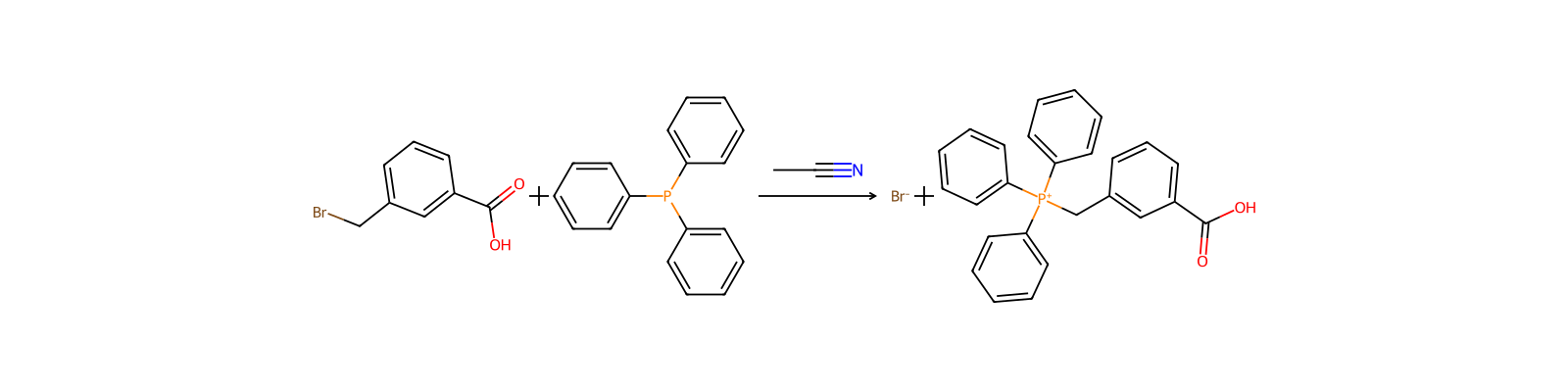
[Br:1][CH2:2][C:3]1[CH:4]=[C:5]([CH:9]=[CH:10][CH:11]=1)[C:6]([OH:8])=[O:7].[C:12]1([P:18]([C:25]2[CH:30]=[CH:29][CH:28]=[CH:27][CH:26]=2)[C:19]2[CH:24]=[CH:23][CH:22]=[CH:21][CH:20]=2)[CH:17]=[CH:16][CH:15]=[CH:14][CH:13]=1>C(#N)C>[Br-:1].[C:6]([C:5]1[CH:4]=[C:3]([CH:11]=[CH:10][CH:9]=1)[CH2:2][P+:18]([C:19]1[CH:20]=[CH:21][CH:22]=[CH:23][CH:24]=1)([C:25]1[CH:30]=[CH:29][CH:28]=[CH:27][CH:26]=1)[C:12]1[CH:13]=[CH:14][CH:15]=[CH:16][CH:17]=1)([OH:8])=[O:7]Participants
4
Reactant 2


Product 1

Reagents, catalysts & solvents 1

Procedure
To a solution of 3-(bromomethyl)benzoic acid (16.50 g, 76.73 mmol) in acetonitrile (76.7 ml) was added triphenylphosphine (22.14 g, 84.40 mmol). After heating the mixture under reflux for 2 hr, the reaction mixture was cooled to room temperature. The precipitate was collected by filtration and dried under reduced pressure to give (3-carboxybenzyl)(triphenyl)phosphoniumbromide (30.13 g, 63.12 mmol, yield 82.3%) as a white solid.
Workup
- temperatureAfter heating the mixture
- temperatureunder reflux for 2 hr
- filtrationThe precipitate was collected by filtration
- customdried under reduced pressure
Sources & evidence
- ORD record
- ord-bbac79a1f17e40f2b9249410567ec8fe
- Source dataset
- uspto-grants-2013_08
- Patent number
- US08507690B2
Reaction notes
Loading…