Imidazole → HCID 728760, compound
Reaction equation

F[C:2]1[CH:7]=[CH:6][C:5]([C:8]([F:11])([F:10])[F:9])=[CH:4][C:3]=1[N+:12]([O-:14])=[O:13].C(N(C(C)C)CC)(C)C.[NH:24]1[CH:28]=[CH:27][N:26]=[CH:25]1>C(#N)C>[N+:12]([C:3]1[CH:4]=[C:5]([C:8]([F:11])([F:10])[F:9])[CH:6]=[CH:7][C:2]=1[N:24]1[CH:28]=[CH:27][N:26]=[CH:25]1)([O-:14])=[O:13]Participants
Reactant 3

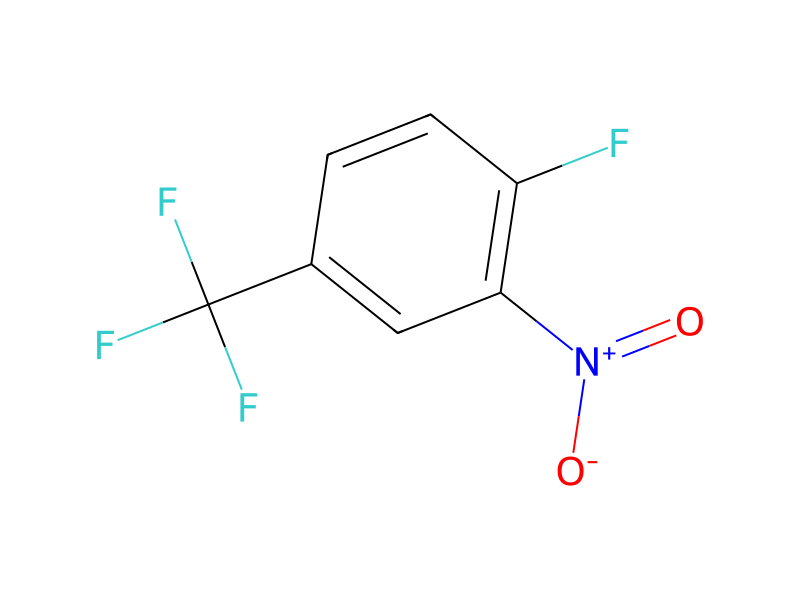

Product 1

Reagents, catalysts & solvents 1

Procedure
To a solution of 1-fluoro-2-nitro-4-(trifluoromethyl)benzene (15.00 g; 71.8 mmol; 1 eq) and diisopropylethylamine (12.5 mL; 71.8 mmol; 1 eq) in anhydrous acetonitrile (650 mL), imidazole (4.88 g; 71.8 mmol; 1 eq) is added under argon. The reaction mixture is allowed to stir under reflux for 20 hours until 1-fluoro-2-nitro-4-(trifluoromethyl)benzene has completely reacted. The crude mixture is concentrated under vacuum and the resulting powder dissolved in ethyl acetate (250 mL). The organic phase is then washed with water (100 mL), brine (100 mL) and dried over sodium sulfate to provide an orange powder after concentration under vacuum. Further purification by flash chromatography on silica gel (ethyl acetate/cyclohexane 5:5) afforded the title compound (17.7 g; 68.5 mmol; 96%) as a brown powder.
Workup
- customhas completely reacted
- concentrationThe crude mixture is concentrated under vacuum
- dissolutionthe resulting powder dissolved in ethyl acetate (250 mL)
- washThe organic phase is then washed with water (100 mL), brine (100 mL)
- dry with materialdried over sodium sulfate
- customto provide an orange powder
- concentrationafter concentration under vacuum
- customFurther purification by flash chromatography on silica gel (ethyl acetate/cyclohexane 5:5)
Sources & evidence
- ORD record
- ord-d413cb14209642b89a42300d556d9723
- Source dataset
- uspto-grants-2013_08
- Patent number
- US08513250B2
Reaction notes
Loading…