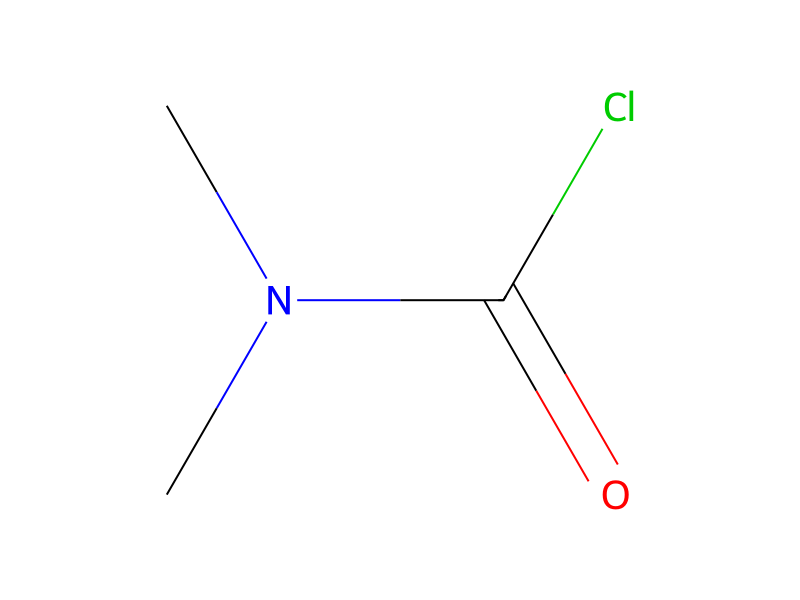
Dimethylcarbamoyl Chloride → HCID 68003686, compound
Reaction equation

Cl.[O:2]1[C:6]2([CH2:11][CH2:10][CH:9]([CH:12]([NH2:15])[CH2:13][CH3:14])[CH2:8][CH2:7]2)[O:5][CH2:4][CH2:3]1.[CH3:16][N:17]([CH3:21])[C:18](Cl)=[O:19]>ClCCl>[O:2]1[C:6]2([CH2:11][CH2:10][CH:9]([CH:12]([NH:15][C:18]([N:17]([CH3:21])[CH3:16])=[O:19])[CH2:13][CH3:14])[CH2:8][CH2:7]2)[O:5][CH2:4][CH2:3]1Participants
4
Reactant 2

Product 1

Reagents, catalysts & solvents 1

Conditions
- Temperature
- 0 °C
Procedure
Into a 50 mL round-bottom flask was placed a solution of 1-1,4-dioxaspiro[4.5]decan-8-ylpropan-1-amine hydrochloride (as prepared in Example 104 Step B) (50 mg, 0.21 mmol, 1.00 equiv) in dichloromethane (10 mL) and TEA (42.8 mg, 0.42 mmol, 2.00 equiv). This was followed by the addition of dimethylcarbamic chloride (27.5 mg, 0.25 mmol, 1.20 equiv) dropwise with stirring at 0° C. The resulting solution was stirred overnight at room temperature. The reaction was then quenched by the addition of 20 mL of water. The resulting solution was extracted with 2×20 mL of dichloromethane. The organic layers were combined, dried over anhydrous sodium sulfate and concentrated under vacuum. The title compound was obtained as a yellow oil.
Workup
- customInto a 50 mL round-bottom flask was placed
- stirringThe resulting solution was stirred overnight at room temperature
- customThe reaction was then quenched by the addition of 20 mL of water
- extractionThe resulting solution was extracted with 2×20 mL of dichloromethane
- dry with materialdried over anhydrous sodium sulfate
- concentrationconcentrated under vacuum
Sources & evidence
- ORD record
- ord-c6e1d4cb7a4f4eeda450645c4925a7f2
- Source dataset
- uspto-grants-2013_08
- Patent number
- US08518969B2
Reaction notes
Loading…