Phenylhydrazine → 5,10-Dihydroindeno[1,2-b]indole
Reaction equation

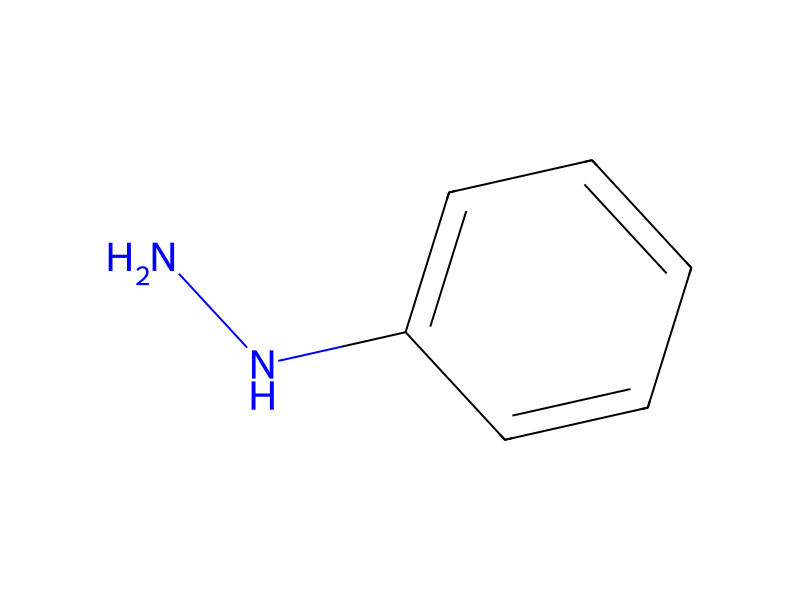
[CH2:1]1[C:9]2[C:4](=[CH:5][CH:6]=[CH:7][CH:8]=2)[CH2:3][C:2]1=O.[C:11]1([NH:17]N)[CH:16]=[CH:15][CH:14]=[CH:13][CH:12]=1>C(O)C.C(O)(=O)C>[CH:8]1[CH:7]=[CH:6][CH:5]=[C:4]2[C:9]=1[CH2:1][C:2]1[C:16]3[CH:15]=[CH:14][CH:13]=[CH:12][C:11]=3[NH:17][C:3]=12Participants
5
Reactant 2

Product 1

Reagents, catalysts & solvents 2


Conditions
- Temperature
- 85 °C
Procedure
A modified version of the method reported by Okamoto, et al. was employed. Okamoto, T. A.; Kobayashi, S. M.; Yamamoto, H. N., DE1952019, 1970. To a solution of 2-indanone (16.3 g, 123 mmol) in ethanol (80 mL) was added phenyl hydrazine (12.1 mL, 123 mmol) followed by acetic acid (12 drops) at room temperature. While stirring, the solution was warmed to reflux (oil bath at 85° C.) for 15 minutes at which point it was removed from the oil bath and allowed to cool to room temperature. Light yellow needle-like crystals precipitated from the solution. Upon cooling to room temperature, the solution was cooled to 0° C. for 30 minutes. The crystals were filtered via vacuum filtration and used without further purification.
Workup
- temperaturethe solution was warmed
- customwas removed from the oil bath
- temperatureto cool to room temperature
- customLight yellow needle-like crystals precipitated from the solution
- temperatureUpon cooling to room temperature
- temperaturethe solution was cooled to 0° C. for 30 minutes
- filtrationThe crystals were filtered via vacuum filtration
- customused without further purification
Sources & evidence
- ORD record
- ord-024396fb633f481f9298eb974539b4ae
- Source dataset
- uspto-grants-2013_08
- Patent number
- US08519122B2
Reaction notes
Loading…