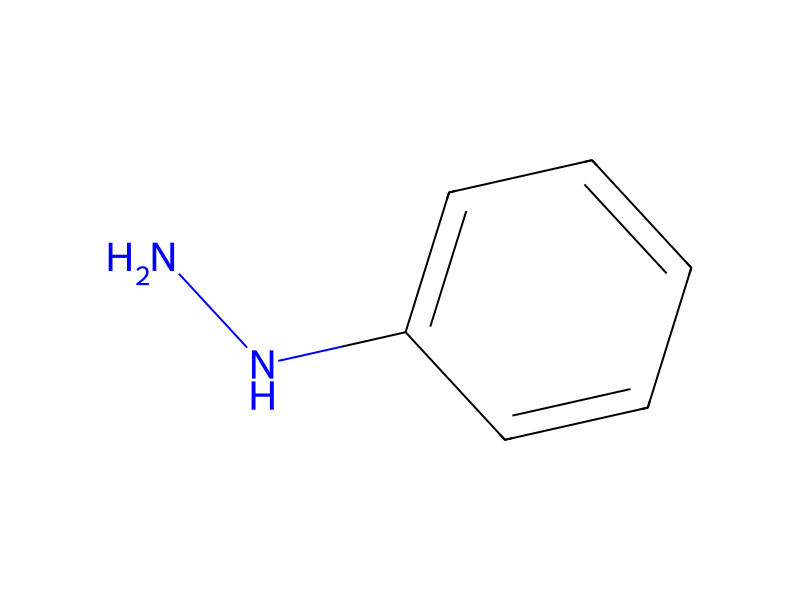
Phenylhydrazine → HCID 58403372, compound
Reaction equation

[C:1]1([NH:7]N)[CH:6]=[CH:5][CH:4]=[CH:3][CH:2]=1.[F:9][C:10]1[CH:18]=[C:17]2[C:13]([CH2:14][CH2:15][C:16]2=O)=[CH:12][CH:11]=1>C(O)C.C(O)(=O)C>[F:9][C:10]1[CH:18]=[C:17]2[C:13]([CH2:14][C:15]3[C:2]4[CH:3]=[CH:4][CH:5]=[CH:6][C:1]=4[NH:7][C:16]=32)=[CH:12][CH:11]=1Participants
Reactant 2

Product 1

Reagents, catalysts & solvents 2


Conditions
- Temperature
- 85 °C
Procedure
To a solution of phenyl hydrazine (1.32 mL, 13.32 mmol) and 6-fluoro-1-indanone (2.02 g, 13.46 mmol) in ethanol (7.6 mL) was added glacial acetic acid (3 drops). The solution was stirred at reflux (85° C.) for 17 minutes and cooled to room temperature. Upon cooling, white crystals precipitated out of solution. These crystals were collected by vacuum filtration and dissolved in isopropanol (23 mL) Sulfuric acid (36N, 1.51 mL) was added via syringe and the resulting solution was stirred at reflux (90° C.) for 18 hours and subsequently cooled to room temperature. The solution was then basified to pH 10 via addition of aqueous sodium hydroxide (2% by mass) resulting in the formation of precipitate. The solid was collected by vacuum filtration to yield 37b as a brown solid in 46% crude yield (1.38 g, 6.17 mmol). Crude product was brought on to the next step without further purification. For purposes of characterization, the product was purified by flash column chromatography (20:1 to 20:1.5 hexanes-ethyl acetate). 1H NMR (600 MHz, CDCl3): δ 8.26 (s, 1H), 7.64-7.65 (d, 1H, J=7.8 Hz), 7.42-7.44 (m, 2H), 7.20-7.23 (td, 1H, J=7.2, 1.2 Hz), 7.16-7.19 (td, J=7.2, 1.2 Hz) 7.12-7.14 (dd, 1H, J=8.4, 2.4 Hz), 6.88-6.91 (m, 1H), 3.68 (s, 1H); 13C NMR (150 MHz, CDCl3): δ 161.5-163.1 (d, J=242 Hz), 142.9 (d, J=2.4 Hz), 142.3 (d, J=2.9 Hz), 140.7, 136.5 (d, J=9.6 Hz), 126.0 (d, J=9.0 Hz), 124.5, 123.9, 122.3, 120.4, 119.2, 112.2, 111.0 (d, J=22.7 HZ), 104.8 (d, J=24.3 Hz), 29.8; FTIR: cm−1 3398, 1589, 1528, 1462, 1268, 1187, 744, 665. ESI-HRMS: Calcd. for C15H10FN+ [M]+: 223.0792, found 223.0792.
Workup
- temperaturecooled to room temperature
- temperatureUpon cooling
- customwhite crystals precipitated out of solution
- filtrationThese crystals were collected by vacuum filtration
- dissolutiondissolved in isopropanol (23 mL) Sulfuric acid (36N, 1.51 mL)
- additionwas added via syringe
- stirringthe resulting solution was stirred
- temperatureat reflux (90° C.) for 18 hours
- temperaturesubsequently cooled to room temperature
- additionThe solution was then basified to pH 10 via addition of aqueous sodium hydroxide (2% by mass)
- customresulting in the formation of precipitate
- filtrationThe solid was collected by vacuum filtration
Sources & evidence
- ORD record
- ord-5c10eee7dc854bc28a0709363bb87c2c
- Source dataset
- uspto-grants-2013_08
- Patent number
- US08519122B2
Reaction notes
Loading…