Diethylenetriaminepentaacetic acid → Acrylamide-acrylic acid resin
Reaction equation

[C:1]([NH2:5])(=[O:4])[CH:2]=[CH2:3].[C:6]([OH:10])(=[O:9])[CH:7]=[CH2:8].[OH-].[Na+].C(N(CC(O)=O)CCN(CC(O)=O)CC(O)=O)CN(CC(O)=O)CC(O)=O.CCCCC(CCC(OS([O-])(=O)=O)CC(C)C)CC.[Na+].C(O)(=O)CCCCCCC/C=C\CCCCCCCC.CCCCCCCC/C=C\CCCCCCCC(OCC(O)[C@H]1OC[C@H](O)[C@H]1O)=O>O>[C:1]([NH2:5])(=[O:4])[CH:2]=[CH2:3].[C:6]([OH:10])(=[O:9])[CH:7]=[CH2:8]Participants
Reactant 7
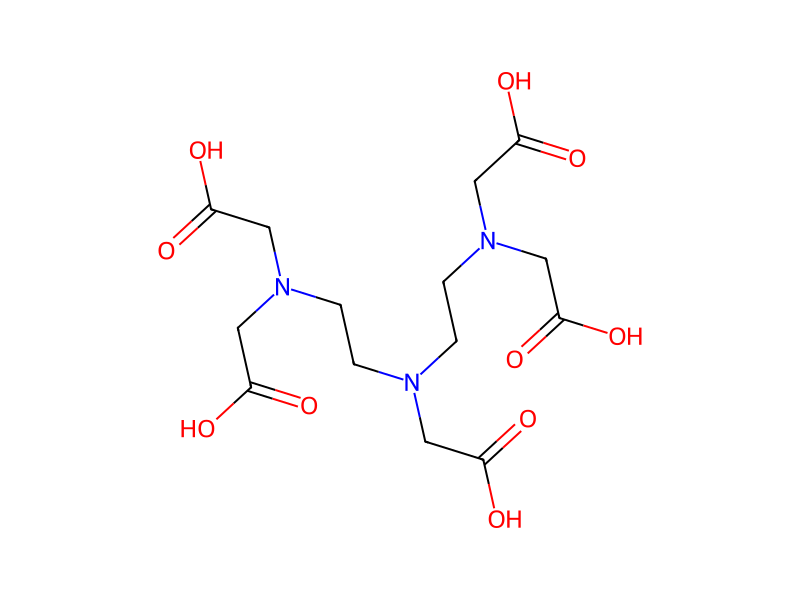





Product 1

Reagents, catalysts & solvents 1

Procedure
A water-in-oil emulsion of an acrylamide/acrylic acid copolymer is prepared by dissolving 334.5 g of acrylamide and 138.3 g of acrylic acid in 302.5 g of water. The pH of the resulting aqueous solution is adjusted to 6.5 by the addition of a 50 percent aqueous solution of NaOH. To this solution is added 0.3 g of the pentasodium salt of diethylenetriaminepentaacetic acid and 5.1 g of a polyethylene glycol ether of a secondary alcohol sold by Union Carbide under the trade name Tergitol 15-S-9 (inverting surfactant). The total weight of this aqueous phase is adjusted to 1260 g by the addition of water. This aqueous phase is then dispersed in an oil phase which contains 457.8 g of liquid hydrocarbon, 12.3 g of isopropanolamide of oleic acid (emulsifier) and 10.2 g of sorbitan monooleate (emulsifier). The resulting emulsion is charged into a jacketed liter glass reactor equipped with a stirrer, a nitrogen sparger, a thermometer, and gas exit. A free-radical initiator is added and the reactor containing the emulsion is sparged with nitrogen for about 1 hour to remove oxygen. The emulsion is then subjected to polymerization conditions as described in U.S. Pat. No. 3,284,393 to form a water-in-oil emulsion of acrylamide/acrylic acid copolymer (preconcentrate emulsion).
Workup
- additionThis aqueous phase is then dispersed in an oil phase which
- additionThe resulting emulsion is charged into a jacketed liter glass reactor
- customequipped with a stirrer
- additionA free-radical initiator is added
- additionthe reactor containing the emulsion
- customis sparged with nitrogen for about 1 hour
- customto remove oxygen
- customThe emulsion is then subjected to polymerization conditions
Sources & evidence
- ORD record
- ord-15e2a67d03624d60a6e6486ae2b29c9d
- Source dataset
- uspto-grants-1984_03
- Patent number
- US04435528
Reaction notes
Loading…