4-Nitrobenzenesulfonyl chloride → HCID 14534079, compound
Reaction equation

[N+:1]([C:4]1[CH:9]=[CH:8][C:7]([S:10](Cl)(=[O:12])=[O:11])=[CH:6][CH:5]=1)([O-:3])=[O:2].[N+:14]([C:17]1[CH:18]=[C:19]2[C:23](=[CH:24][CH:25]=1)[NH:22][N:21]=[CH:20]2)([O-:16])=[O:15].C(N(CC)CC)C>C(#N)C>[N+:14]([C:17]1[CH:18]=[C:19]2[C:23](=[CH:24][CH:25]=1)[N:22]([S:10]([C:7]1[CH:8]=[CH:9][C:4]([N+:1]([O-:3])=[O:2])=[CH:5][CH:6]=1)(=[O:12])=[O:11])[N:21]=[CH:20]2)([O-:16])=[O:15]Participants
5
Reactant 3


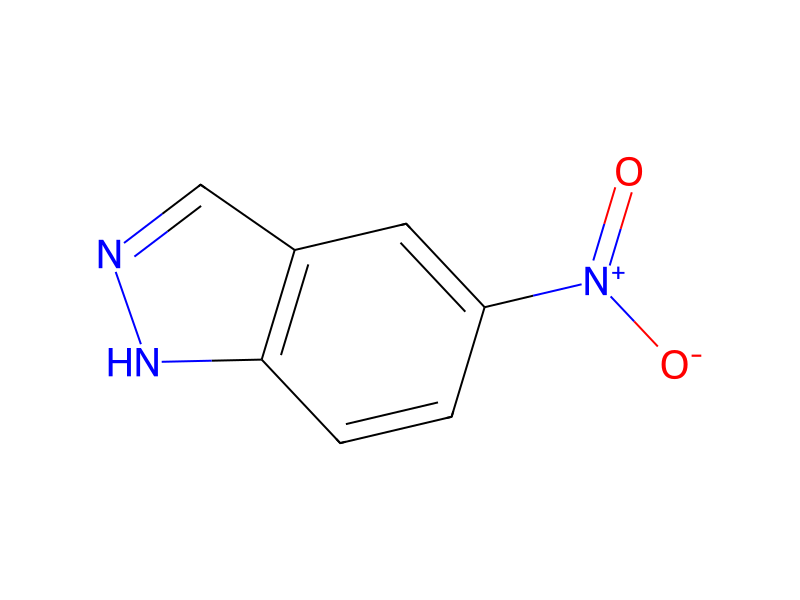
Product 1

Reagents, catalysts & solvents 1

Conditions
- Temperature
- 0 °C
Procedure
In 100 ml of acetonitrile were dissolved 10 g of 4-nitrophenylsulfonyl chloride and 8.8 g of 5-nitroindazole and the solution was cooled to 0° C. Then, 6.8 g of triethylamine was gradually added dropwise to the solution and the mixture was allowed to stand overnight to precipitate crystals. Then, 50 ml of water was added dropwise to the system and the crystals formed were collected by filtration, washed with water and then ethyl acetate, and dried to provide 12.1 g of the desired product having a melting point of from 196° C. to 197° C.
Workup
- customto precipitate crystals
- additionThen, 50 ml of water was added dropwise to the system
- customthe crystals formed
- filtrationwere collected by filtration
- washwashed with water
- dry with materialethyl acetate, and dried
Sources & evidence
- ORD record
- ord-4e913f0c4ee64194b91981382a106456
- Source dataset
- uspto-grants-1989_06
- Patent number
- US04840887
Reaction notes
Loading…