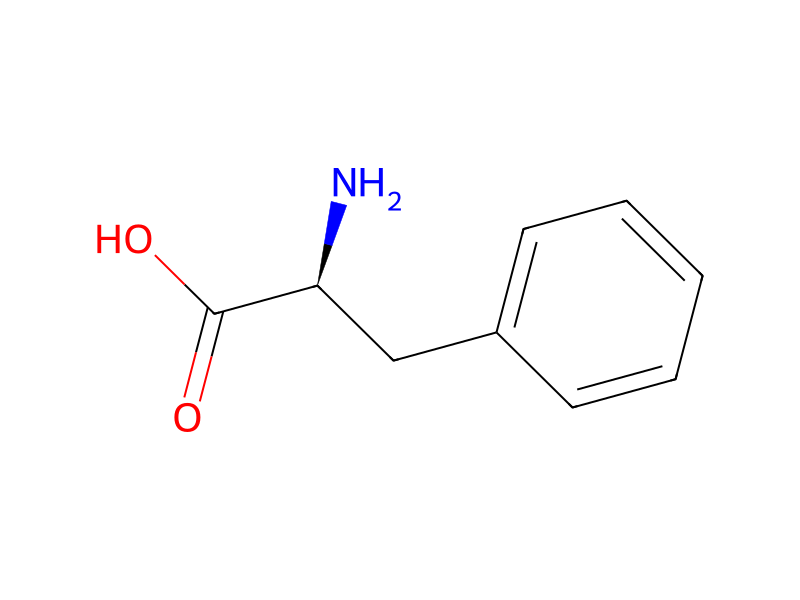
Pyridoxal 5'-phosphate → L-Phenylalanine
Reaction equation

[C:1]1([CH2:7][C:8](=O)[C:9]([O-:11])=[O:10])[CH:6]=[CH:5][CH:4]=[CH:3][CH:2]=1.[NH2:13][C@H](C([O-])=O)CC([O-])=O.[NH4+].[NH4+].CC1C(O)=C(C=O)C(COP(O)(O)=O)=CN=1>O>[NH2:13][C@H:8]([C:9]([OH:11])=[O:10])[CH2:7][C:1]1[CH:6]=[CH:5][CH:4]=[CH:3][CH:2]=1Participants
Reactant 3


Product 1
Reagents, catalysts & solvents 1

Procedure
A batch type process wherein the catalyst compositions are stirred in from 0.01 to 0.5 molar (preferably 0.05 to 0.3 molar) solution of phenylpyruvate in the presence of 0.015 to 0.75 molar ammonium L-aspartate (preferably 0.075 to 0.5 molar) and 0.4 to 0.000001 mmolar pyridoxal 5-phosphate (preferably 0.04 to 0.0004 mmolar in water at 5.0 to 10.0 pH (preferably 7.5 to 9.5 pH) for periods of 1.0 to 100 hours (preferably 8 to 48 hours) at temperatures below 50° C. (preferably 20° to 40° C.). Broadly from 0.05 to 50 g of immobilized cells, preferably from 1.0 to 15 g, are used per 0.1 mole of starting phenylpyruvate. After the conversion, the catalyst compositions may be removed by filtration or the equivalent for reuse in converting fresh batches of phenylpyruvate solutions. The product solutions are obtained in a form suitable for conventional processing to isolate the L-phenylalanine (ion exchange chromotography, precipitation, filtration, washing, recrystallization, drying).
Workup
- customAfter the conversion, the catalyst compositions may be removed by filtration
- customThe product solutions are obtained in a form suitable for conventional processing
Sources & evidence
- ORD record
- ord-795c3417af074574be9989baebcc5cbf
- Source dataset
- uspto-grants-1987_03
- Patent number
- US04650755
Reaction notes
Loading…