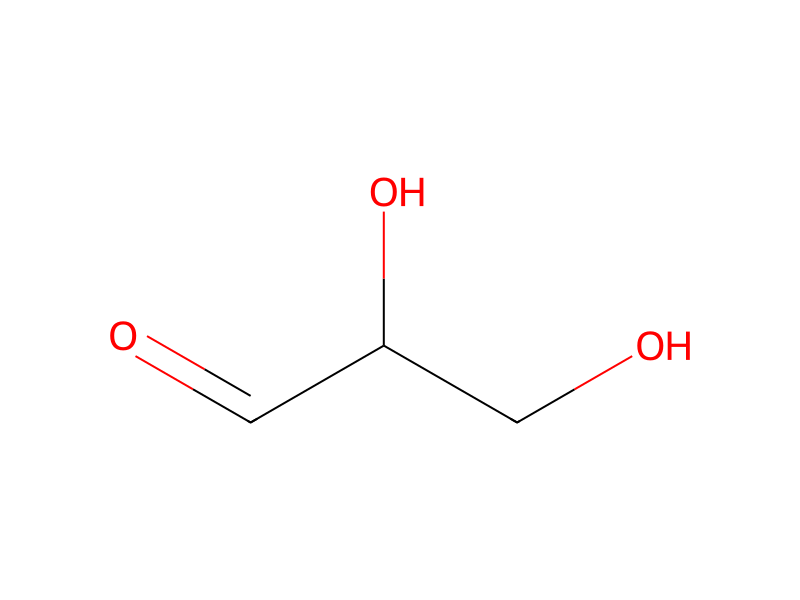
Glyceraldehyde → 3-(Benzylamino)propane-1,2-diol
Reaction equation

[CH2:1](O)[CH:2]([OH:5])[CH:3]=[O:4].[CH2:7]([NH2:14])[C:8]1[CH:13]=[CH:12][CH:11]=[CH:10][CH:9]=1>CO.[Pd]>[CH2:7]([NH:14][CH2:1][CH:2]([OH:5])[CH2:3][OH:4])[C:8]1[CH:13]=[CH:12][CH:11]=[CH:10][CH:9]=1Participants
Reactant 2

Product 1

Reagents, catalysts & solvents 2


Procedure
In yet a further method, N-benzyl-3-[4-[2-(cyclopropylmethoxy)ethyl]phenoxy]-2-hydroxypropylamine was formed in the following manner. D,L-Glyceraldehyde (5.0 g) was added to benzylamine (18.19 g) in methanol (90 ml) and the mixture was hydrogenated at 344 kPa (50 p.s.i.) over 5% palladium on carbon (1.0 g) for 31/2 hours. The mixture was filtered, evaporated under reduced pressure and subjected to column chromatography on silica (eluant dichloromethane:methanol saturated with ammonia 9:1) to give as an oil 3-benzylamino-1,2-propanediol (5.4 g). Part of this (4.9 g) and benzaldehyde (10 ml) were heated to 150° C. for 30 minutes. Volatiles including water were collected by distillation. The mixture was then cooled, benzaldehyde distilled off at low pressure, and the desired product 2-phenyl-3-benzyl-5-hydroxymethyloxazolidine (2.7 g) distilled at 190° C. (0.2 mm Hg). To this oil (2.69 g) in pyridine (4 ml) was added in portions toluene-p-sulphonyl chloride (1.90 g) at 5° C. The mixture was stirred at room temperature for 2 hours, treated with potassium carbonate (1.65 g) in water (7.5 ml), extracted into dichloromethane (3×10 ml) and evaporated under reduced pressure to give an oil. This oil dissolved in dimethylformamide (5 ml) was added in portions, to a solution of the anion of 4-[2-(cyclopropylmethoxy)ethyl]phenol (1.9 g) (prepared in situ using sodium hydride (0.5 g)) in dimethylformamide (5 ml) at 5° C. The mixture was heated for 6 hours to 60°-70° C., cooled, poured on to ice (30 g), extracted into diethyl ether (3×30 ml) and evaporated under reduced pressure to give an oil. This was slurried under water (30 ml), concentrated hydrochloric acid (6 ml) was added, stirred for 30 minutes and ether (30 ml) added. The resultant solid (1.1 g) was filtered off, slurried with ether, filtered and separated between dichloromethane and dilute sodium hydroxide. The dichloromethane layer was dried, filtered and evaporated to give an oil which crystallised on standing to afford N-benzyl-3-[4-[2-(cyclopropylmethoxy)ethyl]phenoxy]-2-hydroxypropylamine (0.8 g), identical with an authentic sample by chromatography and a nuclear magnetic resonance spectrum.
Workup
- custom2 hours
- filtrationThe mixture was filtered
- customevaporated under reduced pressure
Sources & evidence
- ORD record
- ord-9784e15d7ae84c4a9c2b36e233bdff53
- Source dataset
- uspto-grants-1987_03
- Patent number
- US04652563
Reaction notes
Loading…