Potassium Carbonate → 7-(3-Bromo-4-nitrophenyl)-7-azabicyclo[2.2.1]heptane
Reaction equation
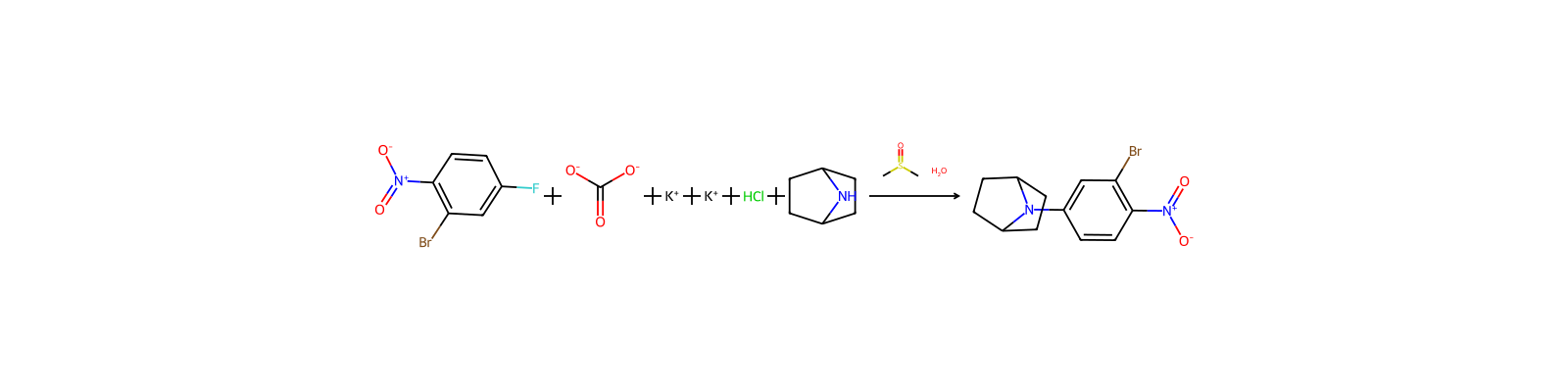
[Br:1][C:2]1[CH:7]=[C:6](F)[CH:5]=[CH:4][C:3]=1[N+:9]([O-:11])=[O:10].C([O-])([O-])=O.[K+].[K+].Cl.[CH:19]12[NH:25][CH:22]([CH2:23][CH2:24]1)[CH2:21][CH2:20]2>CS(C)=O.O>[Br:1][C:2]1[CH:7]=[C:6]([N:25]2[CH:19]3[CH2:24][CH2:23][CH:22]2[CH2:21][CH2:20]3)[CH:5]=[CH:4][C:3]=1[N+:9]([O-:11])=[O:10]Participants
6
Reactant 3



Product 1

Reagents, catalysts & solvents 2


Conditions
- Temperature
- 80 °C
Procedure
To a solution of 2-bromo-4-fluoro-1-nitro-benzene 24 (1.1 g, 4.8 mmol) and K2CO3 (2.0 g, 14.3 mmol) in DMSO (8.400 mL) was added 7-azabicyclo[2.2.1]heptane 7a (765.4 mg, 5.7 mmol) portion-wise. The reaction was stirred at 80° C. for 24 h. The reaction was diluted with water to precipitate the product. The solid was redissolved in dichloromethane, washed with 1.0 N HCl, dried over MgSO4, filtered and concentrated to provide 7-(3-bromo-4-nitrophenyl)-7-azabicyclo[2.2.1]heptane 25 (1.1 g, 78% yield). The crude product was used directly in the next step. LC/MS m/z 299.1 [M+H]+, retention time 1.97 min (RP-C18, 10-99% CH3CN/0.05% TFA over 3 min).
Workup
- customto precipitate the product
- dissolutionThe solid was redissolved in dichloromethane
- washwashed with 1.0 N HCl
- dry with materialdried over MgSO4
- filtrationfiltered
- concentrationconcentrated
Sources & evidence
- ORD record
- ord-aafc9af561054e138e91f84877f79409
- Source dataset
- uspto-grants-2013_12
- Patent number
- US08598205B2
Reaction notes
Loading…