Hydroxyamine hydrochloride → 1-(4-Bromo-2-hydroxy-phenyl)-2,2,2-trifluoro-ethanone oxime
Reaction equation
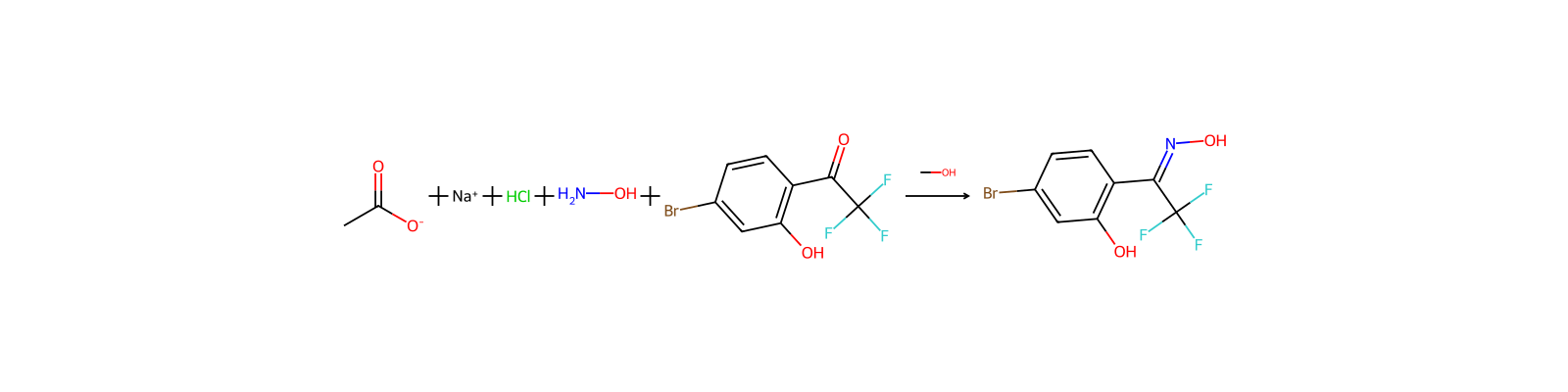
C([O-])(=O)C.[Na+].Cl.[NH2:7][OH:8].[Br:9][C:10]1[CH:15]=[CH:14][C:13]([C:16](=O)[C:17]([F:20])([F:19])[F:18])=[C:12]([OH:22])[CH:11]=1>CO>[Br:9][C:10]1[CH:15]=[CH:14][C:13]([C:16](=[N:7][OH:8])[C:17]([F:20])([F:19])[F:18])=[C:12]([OH:22])[CH:11]=1Participants
5



Conditions
- Temperature
- 64 °C
Procedure
To a round bottom flask were added sodium acetate (9.46 g, 115 mmol), hydroxylamine hydrochloride (7.09 g, 102 mmol) and MeOH (10 mL). To this mixture was added a solution consisting of 1-(4-bromo-2-hydroxy-phenyl)-2,2,2-trifluoro-ethanone (2.5 g, 9.3 mmol) and MeOH (62 mL). The reaction vessel was heated at 64° C. for 7 h before cooling to rt and pouring the reaction mixture into ice water (100 mL). The aqueous solution was then extracted with EtOAc (75 mL×2) and the organic layers dried (Na2SO4) and concentrated to yield the title compound as a mixture of the two possible oxime isomers (2.64 g, 100%).
Workup
- additionTo this mixture was added a solution
- temperaturebefore cooling to rt
- extractionThe aqueous solution was then extracted with EtOAc (75 mL×2)
- dry with materialthe organic layers dried (Na2SO4)
- concentrationconcentrated
Sources & evidence
- ORD record
- ord-44885f25e5fd46ca8b31e5410c47bf48
- Source dataset
- uspto-grants-2013_12
- Patent number
- US08598202B2
Reaction notes
Loading…