Iodine → 6-chloro-3-iodo-7-methoxy-2-methylquinolin-4(1H)-one
Reaction equation
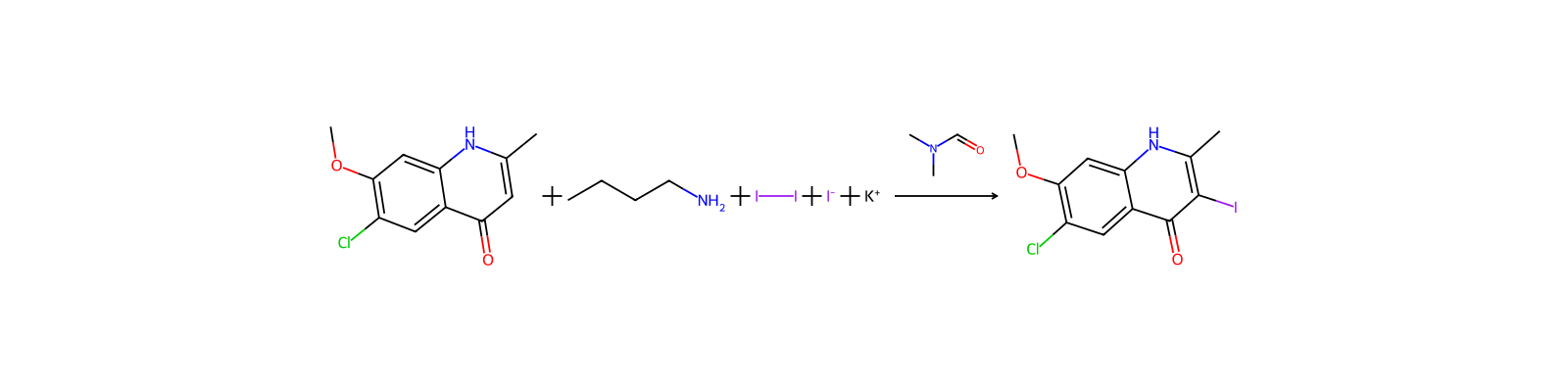
[Cl:1][C:2]1[CH:3]=[C:4]2[C:9](=[CH:10][C:11]=1[O:12][CH3:13])[NH:8][C:7]([CH3:14])=[CH:6][C:5]2=[O:15].C(N)CCC.[I:21]I.[I-].[K+]>CN(C)C=O>[Cl:1][C:2]1[CH:3]=[C:4]2[C:9](=[CH:10][C:11]=1[O:12][CH3:13])[NH:8][C:7]([CH3:14])=[C:6]([I:21])[C:5]2=[O:15]Participants
6





Procedure
To a stirred solution of 6-chloro-7-methoxy-2-methylquinolin-4(1H)-one (6.43 g, 28.7 mmol) and n-butylamine (28 ml, 287 mmol) in dimethylformamide (57 ml) cooled by a room temperature water bath was added iodine (7.30 g, 28.7 mmol) in a saturated solution of aqueous potassium iodide (29 ml). The reaction mixture was stirred 12 hours at room temperature. Residual iodine was quenched with 0.1 M aqueous sodium thiosulfate, and the resulting solution was concentrated in vacuo. The residue was resuspended in water and filtered to give 8.93 g (89% yield) of 6-chloro-3-iodo-7-methoxy-2-methylquinolin-4(1H)-one as a light brown powder.
Workup
- customResidual iodine was quenched with 0.1 M aqueous sodium thiosulfate
- concentrationthe resulting solution was concentrated in vacuo
- filtrationfiltered
Sources & evidence
- ORD record
- ord-02c63bc650d64ef1a6497d9fb85a30e3
- Source dataset
- uspto-grants-2013_12
- Patent number
- US08598354B2
Reaction notes
Loading…