4-Chloroindole → 4-Chloroindoline
Reaction equation

[Cl:1][C:2]1[CH:10]=[CH:9][CH:8]=[C:7]2[C:3]=1[CH:4]=[CH:5][NH:6]2.C([BH3-])#N.[Na+]>C(O)(=O)C.O>[Cl:1][C:2]1[CH:10]=[CH:9][CH:8]=[C:7]2[C:3]=1[CH2:4][CH2:5][NH:6]2Participants
Reactant 2
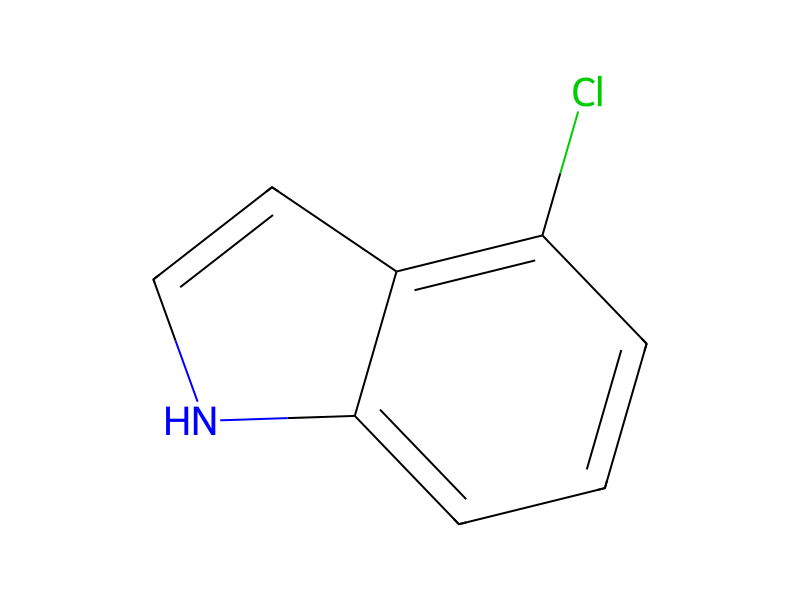

Product 1

Reagents, catalysts & solvents 2


Conditions
- Temperature
- 12 °C
Procedure
To a stirred solution of 4-chloroindole (5 g, 33.0 mmol) in Acetic Acid (50 mL) at 12° C. under nitrogen was added sodium cyanoborohydride (6.84 g, 109 mmol) portionwise. The reaction was stirred at 12° C. for 2 hours. LCMS indicated complete conversion, so the reaction mixture was diluted with water (300 mL), cooled in an ice-bath and quenched with sodium hydroxide pellets portionwise until the mixture was strongly basic. The mixture was then extracted with diethyl ether (3×200 mL) and the combined organics dried over sodium sulfate, concentrated and the residue purified by flash chromatography (0-30% EtOAc in hexanes) to afford 4-chloro-2,3-dihydro-1H-indole (4.0 g) as a colourless oil. LC-MS (ES) m/z=154 [M+H]+. 1H NMR (400 MHz, DMSO-d6) δ ppm 2.94 (t, J=8.59 Hz, 2H), 3.47 (td, J=8.72, 1.77 Hz, 2H), 5.83 (br. s., 1H), 6.40 (d, J=7.83 Hz, 1H), 6.50 (d, J=8.08 Hz, 1H), 6.90 (t, J=7.96 Hz, 1H).
Workup
- temperaturecooled in an ice-bath
- customquenched with sodium hydroxide pellets portionwise until the mixture
- extractionThe mixture was then extracted with diethyl ether (3×200 mL)
- dry with materialthe combined organics dried over sodium sulfate
- concentrationconcentrated
- customthe residue purified by flash chromatography (0-30% EtOAc in hexanes)
Sources & evidence
- ORD record
- ord-d4999bfd3c284e008af5abee02585994
- Source dataset
- uspto-grants-2013_12
- Patent number
- US08598156B2
Reaction notes
Loading…