Triphenylphosphine → HCID 86679999, compound
Reaction equation

[N:1]([CH:4]1[CH:10]([F:11])[CH2:9][CH2:8][N:7]([C:12]2[N:16]([CH3:17])[N:15]=[CH:14][C:13]=2[N+:18]([O-:20])=[O:19])[CH2:6][CH2:5]1)=[N+]=[N-].C1(P(C2C=CC=CC=2)C2C=CC=CC=2)C=CC=CC=1>C1COCC1.O>[F:11][CH:10]1[CH2:9][CH2:8][N:7]([C:12]2[N:16]([CH3:17])[N:15]=[CH:14][C:13]=2[N+:18]([O-:20])=[O:19])[CH2:6][CH2:5][CH:4]1[NH2:1]Participants
Reactant 2


Product 1

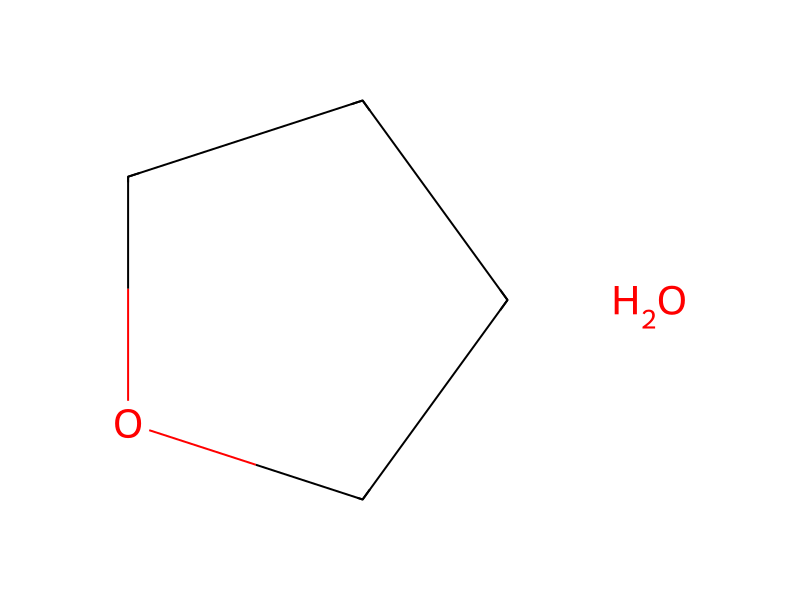
Reagents, catalysts & solvents 1
Conditions
- Temperature
- 60 °C
Procedure
A solution of 4-azido-5-fluoro-1-(1-methyl-4-nitro-1H-pyrazol-5-yl)azepane (1.4 g, 4.95 mmol) in THF/water (30 mL/6 mL) was treated with triphenylphosphine (1.3 g, 4.95 mmol) and the mixture was heated at 60° C. behind a blast screen for 4 hr. The mixture was partitioned between EtOAc (200 mL) and saturated aqueous NaHCO3 solution (30 mL). The aqueous layer was extracted with EtOAc (50 mL) and the combined organic layers were dried over MgSO4 and concentrated under reduced pressure. The resulting oil was triturated with diethyl ether, the resulting solid was filtered off and the filtrate concentrated under reduced pressure to give 5-fluoro-1-(1-methyl-4-nitro-1H-pyrazol-5-yl)azepan-4-amine contaminated with triphenylphosphine oxide as a yellow oil. To a solution of this oil (1.27 g, 4.95 mmol) in dry DCM (40 mL) at 0° C. was added slowly DIPEA (2.6 mL, 14.8 mmol) followed by trifluoroacetic anhydride (0.83 ml, 5.94 mmol) dropwise. The reaction mixture was allowed to warm to room temperature and stirred for 18 hr. Water (40 mL) was added and the mixture was extracted with DCM (150 mL). The organic layer was separated, dried over MgSO4 and concentrated under reduced pressure. Purification via silica gel column chromatography (40% EtOAc/isohexane) gave 2,2,2-trifluoro-N-(5-fluoro-1-(1-methyl-4-nitro-1H-pyrazol-5-yl)azepan-4-yl)acetamide as a yellow viscous oil (1.4 g). To a solution of this oil (1.4 g, 3.97 mmol) and ammonium formate (2.5 g, 39.7 mmol) in MeOH (40 mL) under nitrogen was added 10% palladium on carbon (140 mg). The mixture was heated at 70° C. for 30 min before being cooled, filtered and concentrated under reduced pressure. The residue was partitioned between water (30 mL) and DCM (75 mL). The aqueous layer was extracted with DCM (2×75 mL) and the combined organic layers were separated, dried over MgSO4 and concentrated under reduced pressure to give N-((4S,5R)-1-(4-amino-1-methyl-1H-pyrazol-5-yl)-5-fluoroazepan-4-yl)-2,2,2-trifluoroacetamide as an orange-yellow glass (1.1 g, 69% over three steps). 1H NMR (400 MHz, CDCl3) δ 7.47 (s, 1H), 7.12 (s, 1H), 5.02-4.85 (m, 1H), 4.69-4.55 (m, 1H), 3.66 (s, 3H), 3.42-3.20 (m, 3H), 3.11 (ddd, J=14.4, 6.7, 3.3 Hz, 1H), 2.36-2.22 (m, 1H), 2.23-1.94 (m, 2H), 1.90-1.82 (m, 1H). NH2 not observed.
Workup
- customThe mixture was partitioned between EtOAc (200 mL) and saturated aqueous NaHCO3 solution (30 mL)
- extractionThe aqueous layer was extracted with EtOAc (50 mL)
- dry with materialthe combined organic layers were dried over MgSO4
- concentrationconcentrated under reduced pressure
- customThe resulting oil was triturated with diethyl ether
- filtrationthe resulting solid was filtered off
- concentrationthe filtrate concentrated under reduced pressure
Sources & evidence
- ORD record
- ord-5e4b4f78d64643e69088229407527f7a
- Source dataset
- uspto-grants-2013_12
- Patent number
- US08614206B2
Reaction notes
Loading…