Water → 4-(4-(3-(2-methoxy-5-(trifluoromethyl)phenyl)ureido)phenoxy)-N-methylpicolinamide
Reaction equation

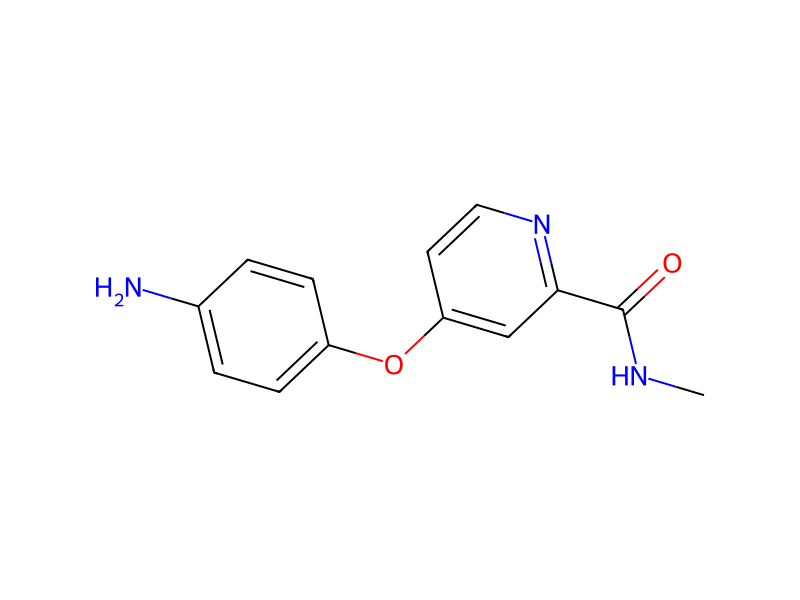
[CH3:1][O:2][C:3]1[CH:9]=[CH:8][C:7]([C:10]([F:13])([F:12])[F:11])=[CH:6][C:4]=1[NH2:5].C1N=CN([C:19](N2C=NC=C2)=[O:20])C=1.[CH3:26][NH:27][C:28]([C:30]1[CH:35]=[C:34]([O:36][C:37]2[CH:43]=[CH:42][C:40]([NH2:41])=[CH:39][CH:38]=2)[CH:33]=[CH:32][N:31]=1)=[O:29].O>C(Cl)Cl>[CH3:1][O:2][C:3]1[CH:9]=[CH:8][C:7]([C:10]([F:11])([F:12])[F:13])=[CH:6][C:4]=1[NH:5][C:19]([NH:41][C:40]1[CH:42]=[CH:43][C:37]([O:36][C:34]2[CH:33]=[CH:32][N:31]=[C:30]([C:28](=[O:29])[NH:27][CH3:26])[CH:35]=2)=[CH:38][CH:39]=1)=[O:20]Participants
Reactant 4
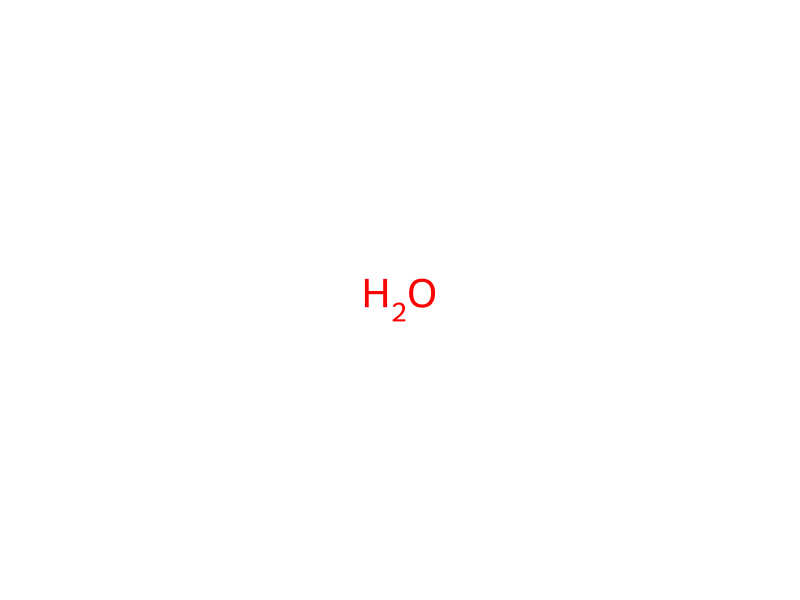


Product 1

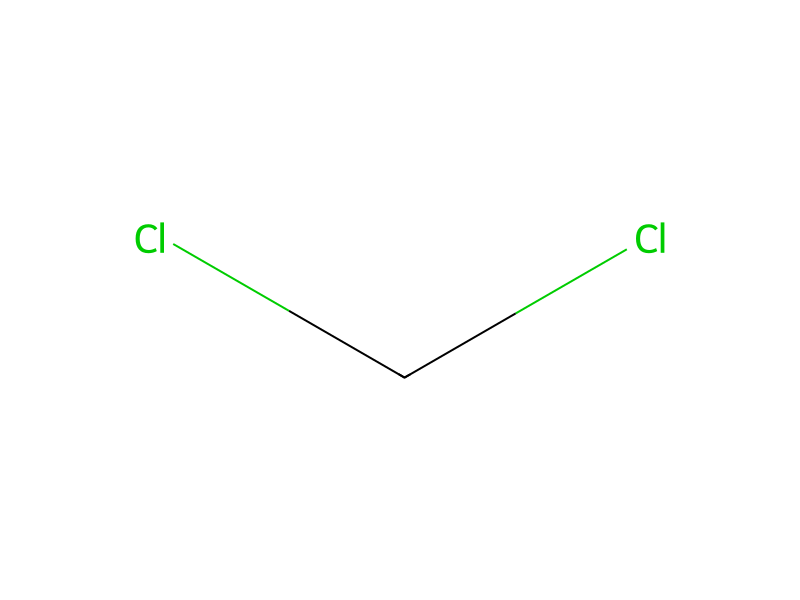
Reagents, catalysts & solvents 1
Procedure
4-Chloro-N-methyl-2-pyridinecarboxamide is first synthesized from 4-chloropyridine-2-carbonyl chloride by adding 4-chloropyridine-2-carbonyl chloride HCl salt (7.0 g, 32.95 mmol) in portions to a mixture of a 2.0 M methylamine solution in THF (100 mL) and MeOH (20 mL) at 0° C. The resulting mixture is stored at 3° C. for 4 h, then concentrated under reduced pressure. The resulting nearly dry solids are suspended in EtOAc (100 mL) and filtered. The filtrate is washed with a saturated NaCl solution (2×100 mL), dried (Na2SO4) and concentrated under reduced pressure to provide 4-chloro-N-methyl-2-pyridinecarboxamide as a yellow, crystalline solid. Step 2: A solution of 4-aminophenol (9.60 g, 88.0 mmol) in anh. DMF (150 mL) is treated with potassium tert-butoxide (10.29 g, 91.7 mmol), and the reddish-brown mixture is stirred at room temp. for 2 h. The contents are treated with 4-chloro-N-methyl-2-pyridinecarboxamide (15.0 g, 87.9 mmol) from Step 1 and K2CO3 (6.50 g, 47.0 mmol) and then heated at 80° C. for 8 h. The mixture is cooled to room temp. and separated between EtOAc (500 mL) and a saturated NaCl solution (500 mL). The aqueous phase is back-extracted with EtOAc (300 mL). The combined organic layers are washed with a saturated NaCl solution (4×1000 mL), dried (Na2SO4) and concentrated under reduced pressure. The resulting solids are dried under reduced pressure at 35° C. for 3 h to afford 4-(2-(N-methylcarbamoyl)-4-pyridyloxy)aniline as a light-brown solid. 1H-NMR (DMSO-d6) δ 2.77 (d, J=4.8 Hz, 3H), 5.17 (br s, 2H), 6.64, 6.86 (AA′BB′ quartet, J=8.4 Hz, 4H), 7.06 (dd, 2.5 Hz, 1H), 7.33 (d, J=2.5 Hz, 1H), 8.44 (d, J=5.5 Hz, 1H), 8.73 (br d, 1H); HPLC ES-MS m/z 244 ((M+H)+). Step 3: To a solution of 2-methoxy-5-(trifluoromethyl)aniline (0.15 g) in anh CH2Cl2 (15 mL) at 0° C. is added CDI (0.13 g). The resulting solution is allowed to warm to room temp. over 1 h, is stirred at room temp. for 16 h, then is treated with 4-(2-(N-methylcarbamoyl)-4-pyridyloxy)aniline (0.18 g) from Step 2. The resulting yellow solution is stirred at room temp. for 72 h, then is treated with H2O (125 mL). The resulting aqueous mixture is extracted with EtOAc (2×150 mL). The combined organics are washed with a saturated NaCl solution (100 mL), dried (MgSO4) and concentrated under reduced pressure. The residue is triturated (90% EtOAc/10% hexane). The resulting white solids are collected by filtration and washed with EtOAc. The filtrate is concentrated under reduced pressure and the residual oil purified by column chromatography (gradient from 33% EtOAc/67% hexane to 50% EtOAc/50% hexane to 100% EtOAc) to give N-(2-methoxy-5-(trifluoromethyl)phenyl)-N′-(4-(2-(N-methylcarbamoyl)-4-pyridyloxy)phenyl)urea as a light tan solid: TLC (100% EtOAc) Rf 0.62; 1H NMR (DMSO-d6) δ 2.76 (d, J=4.8 Hz, 3H), 3.96 (s, 3H), 7.1-7.6 and 8.4-8.6 (m, 11H), 8.75 (d, J=4.8 Hz, 1H), 9.55 (s, 1H); FAB-MS m/z 461 ((M+H)+).
Workup
- temperatureto warm to room temp. over 1 h
- stirringThe resulting yellow solution is stirred at room temp. for 72 h
- extractionThe resulting aqueous mixture is extracted with EtOAc (2×150 mL)
- washThe combined organics are washed with a saturated NaCl solution (100 mL)
- dry with materialdried (MgSO4)
- concentrationconcentrated under reduced pressure
- customThe residue is triturated (90% EtOAc/10% hexane)
- filtrationThe resulting white solids are collected by filtration
- washwashed with EtOAc
- concentrationThe filtrate is concentrated under reduced pressure
- customthe residual oil purified by column chromatography (gradient from 33% EtOAc/67% hexane to 50% EtOAc/50% hexane to 100% EtOAc)
Sources & evidence
- ORD record
- ord-dc1114a3d94f40158b703fbe10a99a01
- Source dataset
- uspto-grants-2013_12
- Patent number
- US08618141B2
Reaction notes
Loading…