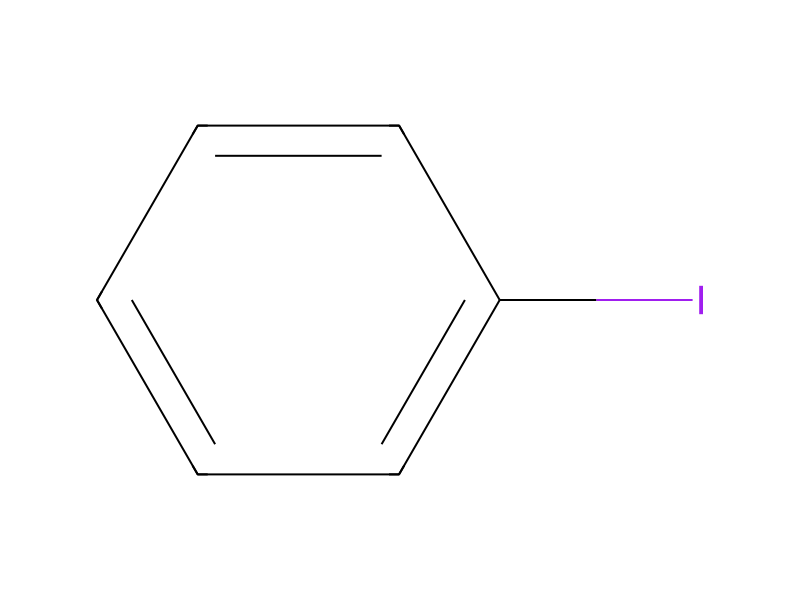
Iodobenzene → HCID 69074101, compound
Reaction equation

[I:1][C:2]1[CH:7]=[CH:6][CH:5]=[CH:4][CH:3]=1.C1(P(C2C=CC=CC=2)C2C=CC=CC=2)C=CC=CC=1.[N:27]1([CH2:33][CH:34]([OH:36])[CH3:35])[CH2:32][CH2:31][CH2:30][CH2:29][CH2:28]1.N(C(OC(C)C)=O)=NC(OC(C)C)=O>C(Cl)Cl.O>[I:1][C:2]1[CH:7]=[CH:6][C:5]([O:36][CH:34]([CH3:35])[CH2:33][N:27]2[CH2:32][CH2:31][CH2:30][CH2:29][CH2:28]2)=[CH:4][CH:3]=1Participants
7






Procedure
1.54 g (7.00 mmol) iodobenzene and 2.75 g (10.5 mmol) triphenylphosphane are added successively to a solution of 1.00 g (6.98 mmol) 1-piperidin-1-yl-propan-2-ol in 20 mL DCM. 2.19 mL (10.5 mmol, 95%) diisopropyl azodicarboxylate is added dropwise at RT and the reaction is stirred for 2 h at RT. It is diluted with water, the organic phase is washed with water and dried over MgSO4. After the desiccant and solvent have been eliminated the residue is purified by chromatography (silica gel, DCM/MeOH 9:1). The oily residue is triturated with diisopropylether, filtered off from the insoluble residue and the filtrate is evaporated to dryness i.vac.
Workup
- washthe organic phase is washed with water
- dry with materialdried over MgSO4
- customis purified by chromatography (silica gel, DCM/MeOH 9:1)
- customThe oily residue is triturated with diisopropylether
- filtrationfiltered off from the insoluble residue
- customthe filtrate is evaporated to dryness i.vac
Sources & evidence
- ORD record
- ord-b6261c3176534e5a80a1fbba7fc85fc7
- Source dataset
- uspto-grants-2013_12
- Patent number
- US08618132B2
Reaction notes
Loading…