Acetone → (E)-4-(2-bromo-4-fluorophenyl)but-3-en-2-one
Reaction equation
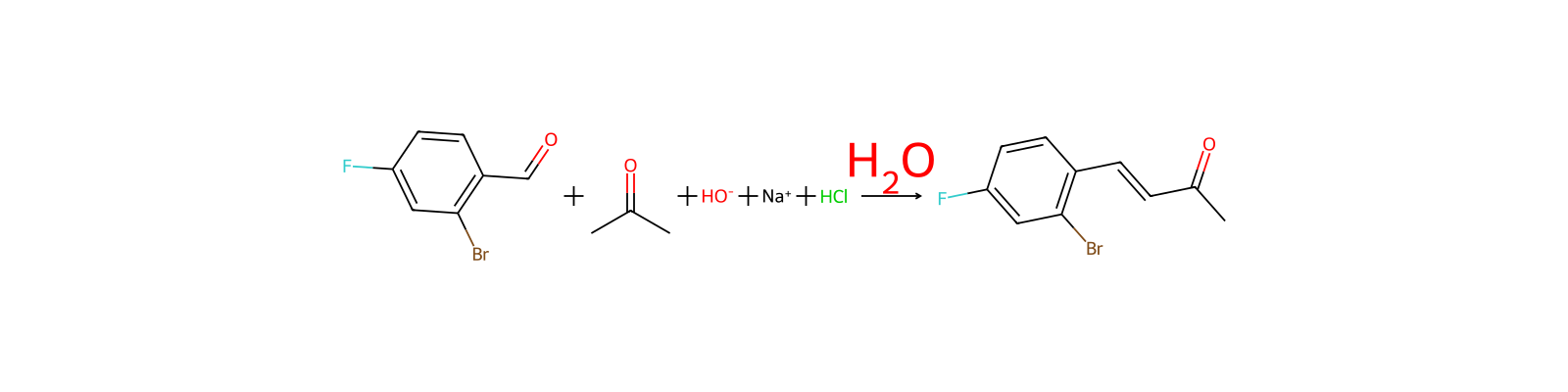
[Br:1][C:2]1[CH:9]=[C:8]([F:10])[CH:7]=[CH:6][C:3]=1[CH:4]=O.[CH3:11][C:12]([CH3:14])=[O:13].[OH-].[Na+].Cl>O>[Br:1][C:2]1[CH:9]=[C:8]([F:10])[CH:7]=[CH:6][C:3]=1/[CH:4]=[CH:11]/[C:12](=[O:13])[CH3:14]Participants
Reactant 4




Product 1

Reagents, catalysts & solvents 1

Conditions
- Temperature
- 0 °C
Procedure
To a 500 mL recovery flask was added 2-bromo-4-fluorobenzaldehyde (1A, 10.0 g, 49.3 mmol, 1.0 eq.) and acetone (22.9 g, 394 mmol, 8.0 eq.). The mixture was cooled to 0° C. in an ice bath. H2O (200 mL) was added and the mixture became a thick suspension. Solid NaOH (2.16 g, 54.2 mmol, 1.1 eq.) was added and the reaction was gradually warmed to room temperature and stirred overnight. The reaction was acidified with 1N HCl and extracted with EtOAc (3×100 mL). The organic phases were combined and washed with saturated aqueous NaCl. The organic phase was dried over anhydrous Na2SO4, filtered, and concentrated to give a dark yellow oil that was carried on to the next step without further purification (11.9 g, 99%). ESI-MS: m/z 243.2 (M+H)+.
Workup
- temperaturethe reaction was gradually warmed to room temperature
- extractionextracted with EtOAc (3×100 mL)
- washwashed with saturated aqueous NaCl
- dry with materialThe organic phase was dried over anhydrous Na2SO4
- filtrationfiltered
- concentrationconcentrated
- customto give a dark yellow oil that
- customwas carried on to the next step without further purification (11.9 g, 99%)
Sources & evidence
- ORD record
- ord-aabdde72e90e413d86aca96ab0f06287
- Source dataset
- uspto-grants-2013_12
- Patent number
- US08618290B2
Reaction notes
Loading…