2-Acetylthiazole → HCID 58516282, compound
Reaction equation

[S:1]1[CH:5]=[CH:4][N:3]=[C:2]1[C:6](=[O:8])[CH3:7]>CS(C)=O.C([O-])(=O)C.[Ag+].C1C=CC(P(C2C=CC=CC=2)[C-]2C=CC=C2)=CC=1.C1C=CC(P(C2C=CC=CC=2)[C-]2C=CC=C2)=CC=1.Cl[Pd]Cl.[Fe+2]>[S:1]1[C:5]([C:5]2[S:1][C:2]([C:6](=[O:8])[CH3:7])=[N:3][CH:4]=2)=[CH:4][N:3]=[C:2]1[C:6](=[O:8])[CH3:7]Participants
5
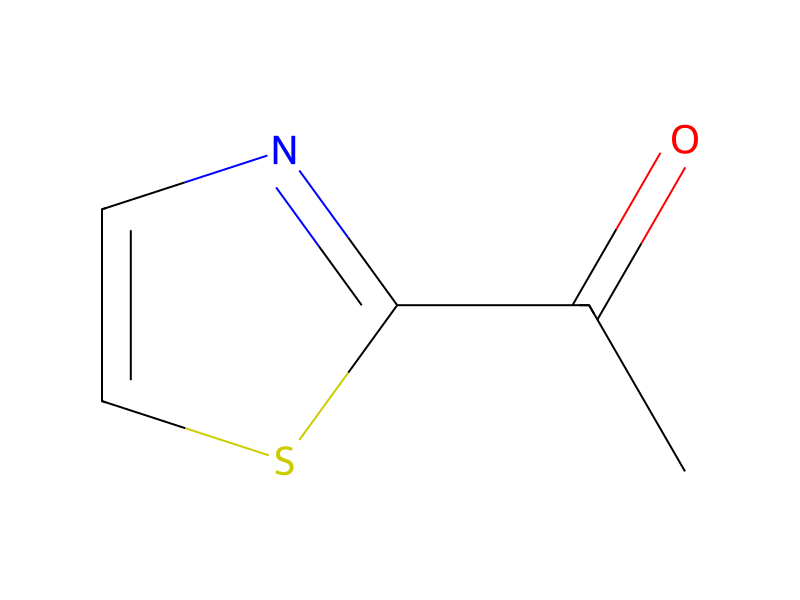



Conditions
- Temperature
- 60 °C
Procedure
Silver acetate (4.0 mL, 79 mmol) was added to a stirred solution of [1,1′-bis(diphenylphosphino)ferrocene]dichloro-palladium(II) (0.970 g, 1.18 mmol), and 1-(thiazol-2-yl)ethanone (5.0 g, 39 mmol) in dimethylsulfoxide (235 mL). The reaction was purged with nitrogen and heated at 60° C. for 8 h. The reaction mixture was cooled, filtered through CELITE®, and washed with dichloromethane and water. The layers were separated and the organic was concentrated to dryness. The crude material was dry loaded onto silica gel and purified by flash chromatography (eluted with a gradient of 0 to 10% methanol in dichloromethane) to yield 1,1′-(5,5′-bithiazole-2,2′-diyl)diethanone (1.2 g) as a brown solid.
Workup
- customThe reaction was purged with nitrogen
- temperatureThe reaction mixture was cooled
- filtrationfiltered through CELITE®
- washwashed with dichloromethane and water
- customThe layers were separated
- concentrationthe organic was concentrated to dryness
- dry with materialThe crude material was dry
- custompurified by flash chromatography (
- washeluted with a gradient of 0 to 10% methanol in dichloromethane)
Sources & evidence
- ORD record
- ord-b70b5094551441e6899fbd7da54bec0f
- Source dataset
- uspto-grants-2013_12
- Patent number
- US08618153B2
Reaction notes
Loading…