Ammonia → HCID 86647869, compound
Reaction equation

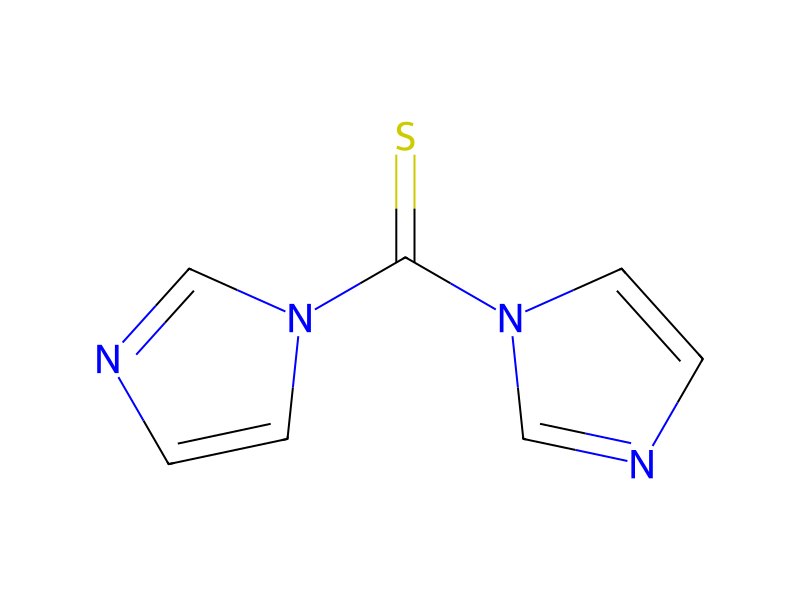
[Br:1][C:2]1[CH:11]=[CH:10][C:5]2[NH:6][CH2:7][CH2:8][O:9][C:4]=2[CH:3]=1.[C:12](N1C=CN=C1)([N:14]1C=CN=C1)=[S:13].N>C1COCC1>[Br:1][C:2]1[CH:11]=[CH:10][C:5]2[N:6]([C:12](=[S:13])[NH2:14])[CH2:7][CH2:8][O:9][C:4]=2[CH:3]=1Participants
Reactant 3


Product 1

Reagents, catalysts & solvents 1

Conditions
- Temperature
- 120 °C
Procedure
A mixture of 7-bromo-3,4-dihydro-2H-benzo[1,4]oxazine (7.07 g, 33.00 mmol) and 1,1′-thiocarbonyldiimidazole (8.86 g, 49.70 mmol) in THF (83 mL) was heated to 120° C. under microwave irradiation, in a sealed tube, for 20 minutes, and then cooled to r.t. NH3 (110 mL, 7N solution in MeOH, 770 mmol) was added. The reaction mixture was stirred at r.t. for 16 h, and then concentrated in vacuo. The residue was triturated with 1M aqueous HCl, then Et2O, water and again Et2O, and then dried in vacuo to give the title compound (5.31 g, 59%) as a cream solid. δH (DMSO-d6) 8.66-7.53 (2H, m), 7.39 (1H, d, J 8.7 Hz), 7.15 (1H, d, J 2.3 Hz), 7.07 (1H, dd, J 8.9 and 2.3 Hz), 4.30-4.20 (4H, m). LCMS (ES+) 272.9 and 274.9 (M+H)+, RT 3.12 minutes (Method 7).
Workup
- temperaturecooled to r.t
- concentrationconcentrated in vacuo
- customThe residue was triturated with 1M aqueous HCl
- dry with materialEt2O, water and again Et2O, and then dried in vacuo
Sources & evidence
- ORD record
- ord-8150890fcf20491194496cef66c7cb18
- Source dataset
- uspto-grants-2012_05
- Patent number
- US08168634B2
Reaction notes
Loading…