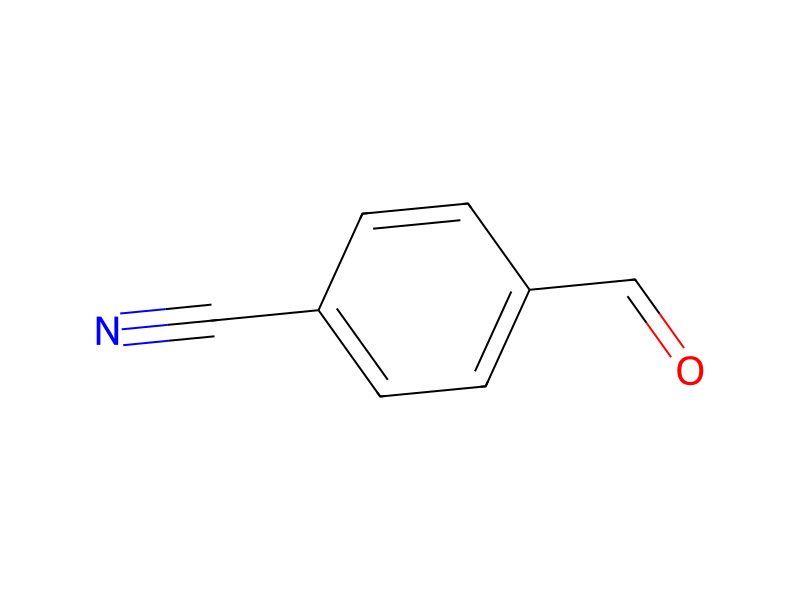
Octanoic Acid → 4-Cyanobenzaldehyde
Reaction equation

[O:1]1CCO[CH:2]1[C:6]1[CH:13]=[CH:12][C:9]([CH2:10][NH2:11])=[CH:8][CH:7]=1.C(O)(=O)CCCCCCC.C1CCC(N=C=NC2CCCCC2)CC1.C1C=CC2N(O)N=NC=2C=1>ClCCl>[C:10]([C:9]1[CH:12]=[CH:13][C:6]([CH:2]=[O:1])=[CH:7][CH:8]=1)#[N:11]Participants
6





Procedure
The 4-(1,3-dioxacyclopent-2-yl)benzylamine is condensed with octanoic acid in dichloromethane in the presence of a peptide coupling system consisting of DCC and HOBt according to a method already described (Ouari O.; Polidori A.; Pucci B.; Tordo P.: Chalier F. J. Org. Chem. 1999, 64, 3554-3556) and then the dioxolane protecting group is removed by treatment in a 1:1, v/v, acetic acid/water mixture. Compound 3 is subsequently purified by silica gel chromatography (eluent: cyclohexane/EtOAc, 6:4, v/v) to give a white powder with a yield of 40% from the 4-cyanobenzaldehyde.
Workup
- customthe dioxolane protecting group is removed by treatment in a 1:1, v/v, acetic acid/water mixture
- customCompound 3 is subsequently purified by silica gel chromatography (eluent: cyclohexane/EtOAc, 6:4, v/v)
Sources & evidence
- ORD record
- ord-06567bf4ccce44dfa8543fe72c56cd12
- Source dataset
- uspto-grants-2012_05
- Patent number
- US08173843B2
Reaction notes
Loading…