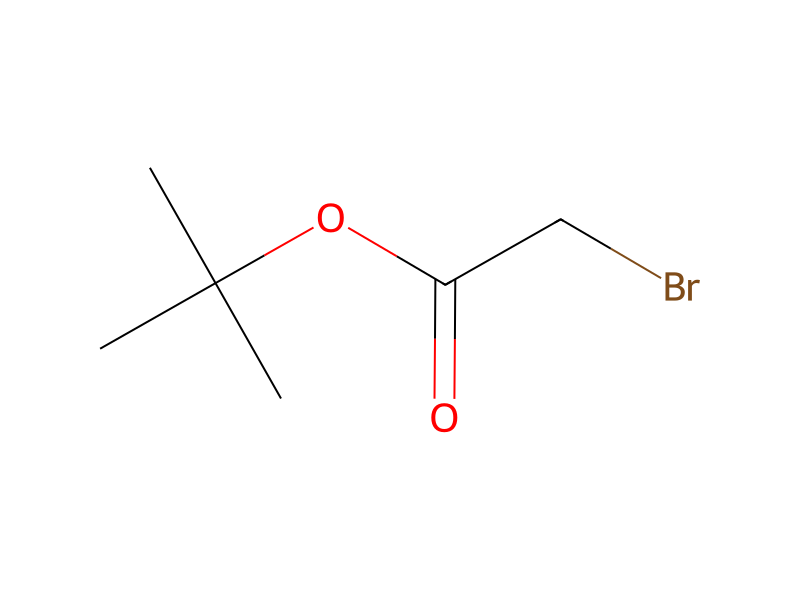
tert-Butyl bromoacetate → HCID 68509507, compound
Reaction equation

Br[CH2:2][C:3]([O:5][C:6]([CH3:9])([CH3:8])[CH3:7])=[O:4].[F:10][C:11]([F:23])([F:22])[C:12]1[C:16]([C:17]([O:19][CH2:20][CH3:21])=[O:18])=[CH:15][NH:14][N:13]=1.C(=O)(O)[O-].[Na+]>ClCCl>[C:6]([O:5][C:3](=[O:4])[CH2:2][N:14]1[CH:15]=[C:16]([C:17]([O:19][CH2:20][CH3:21])=[O:18])[C:12]([C:11]([F:10])([F:22])[F:23])=[N:13]1)([CH3:9])([CH3:8])[CH3:7]Participants
5
Reactant 3


Product 1

Reagents, catalysts & solvents 1

Procedure
404 mg of Hünig-base and 469 mg of tert-butyl bromoacetate, dissolved in 2 ml of dichloromethane, are added to a solution of 50 mg of ethyl 3-(trifluoromethyl)-1H-pyrazole-4-carboxylate in 10 ml of dichloromethane. The mixture is stirred at room temperature for 16 hours. After addition of saturated sodium bicarbonate solution, the mixture is extracted with ethyl acetate, the organic phase is separated off and dried over sodium sulphate and the solvent is removed under reduced pressure. This gives 742 mg of ethyl 1-(2-tert-butoxy-2-oxoethyl)-3-(trifluoromethyl)-1H-pyrazole-4-carboxylate (Va-10) in a purity of about 78% (LCMS).
Workup
- extractionthe mixture is extracted with ethyl acetate
- customthe organic phase is separated off
- dry with materialdried over sodium sulphate
- customthe solvent is removed under reduced pressure
Sources & evidence
- ORD record
- ord-d30f2fe089ec4c369102fc79989bece5
- Source dataset
- uspto-grants-2012_05
- Patent number
- US08183351B2
Reaction notes
Loading…