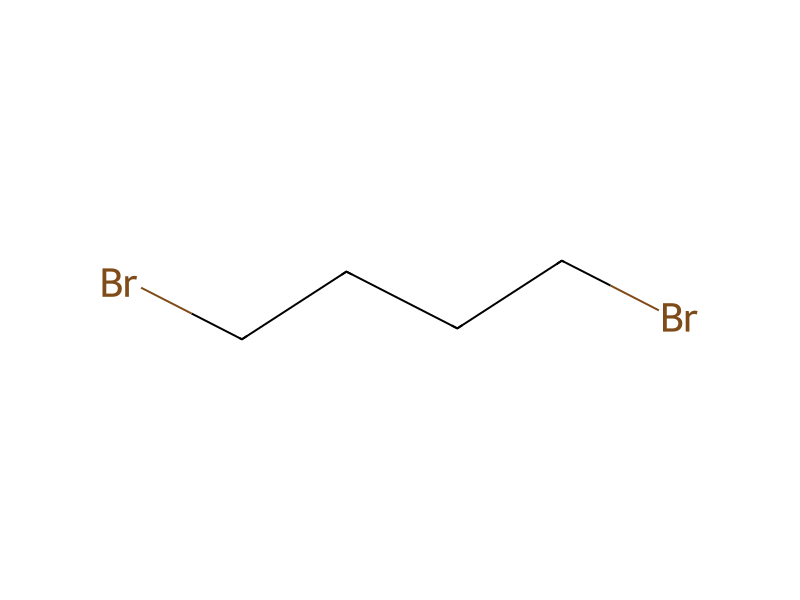
1,4-Dibromobutane → HCID 57467384, compound
Reaction equation

[OH:1][C:2]1[CH:14]=[CH:13][C:5]([O:6][CH2:7][C:8]([O:10][CH2:11][CH3:12])=[O:9])=[C:4]([N+:15]([O-:17])=[O:16])[CH:3]=1.C(=O)([O-])[O-].[K+].[K+].[Br:24][CH2:25][CH2:26][CH2:27][CH2:28]Br>CC(C)=O>[Br:24][CH2:25][CH2:26][CH2:27][CH2:28][O:1][C:2]1[CH:14]=[CH:13][C:5]([O:6][CH2:7][C:8]([O:10][CH2:11][CH3:12])=[O:9])=[C:4]([N+:15]([O-:17])=[O:16])[CH:3]=1Participants
Reactant 3


Product 1

Reagents, catalysts & solvents 1

Procedure
To a solution of ethyl 2-(4-hydroxy-2-nitrophenoxy)acetate 9 (0.17 g, 0.0007 mol) in 10 mL acetone was added potassium carbonate (0.39 g, 0.0028 mol). The reaction mixture was stirred at room temperature for 10 min. Then 1,4-dibromobutane 10 (0.33 mL, 0.0028 mol) was added. The resulting mixture was heated at reflux for 12 h. The progress of the reaction was monitored by thin layer chromatography (TLC). Acetone was evaporated and the residue was diluted with water, extracted with ethyl acetate and dried over sodium sulfate to give ethyl 2-(4-(4-bromobutoxy)-2-nitrophenoxy)acetate 11 which was purified by silica gel column chromatography using 0-20% gradient of hexane and ethyl acetate. Yellow oil (0.52 g, 92%). 1H NMR (400 MHz, CDCl3): δ 1.26 (t, J=6.8 Hz, 3H); 1.91-1.98 (m, 2H); 2.02-2.09 (m, 2H); 3.48 (t, J=6.8 Hz, 2H); 3.99 (t, J=6.0 Hz, 2H); 4.26 (q, J=6.8 Hz, 2H); 4.70 (s, 2H); 6.99-7.02 (m, 2H); 7.38 (d, J=3.2 Hz, 1H).
Workup
- temperatureThe resulting mixture was heated
- temperatureat reflux for 12 h
- customAcetone was evaporated
- additionthe residue was diluted with water
- extractionextracted with ethyl acetate
- dry with materialdried over sodium sulfate
Sources & evidence
- ORD record
- ord-7b85182fd88c4f49861ce02ef0f1c787
- Source dataset
- uspto-grants-2012_05
- Patent number
- US08188076B2
Reaction notes
Loading…