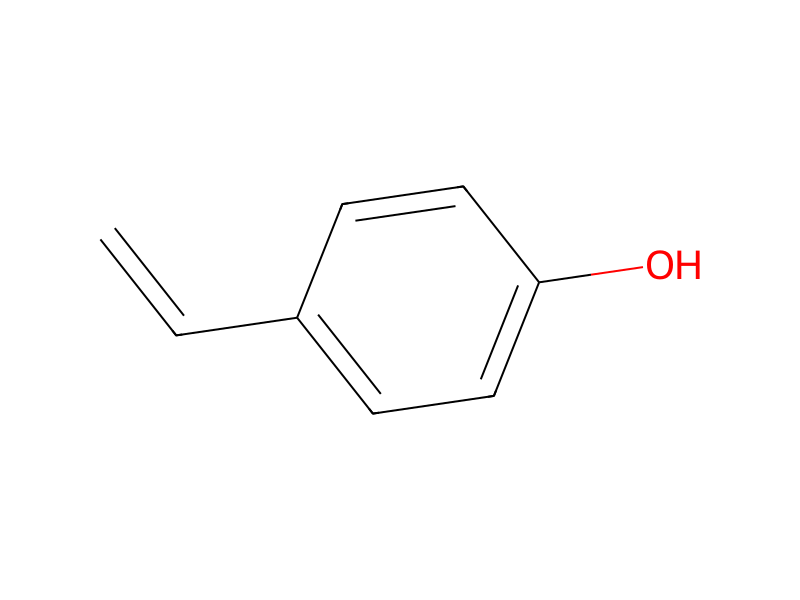
Potassium Hydroxide → 4-Vinylphenol
Reaction equation

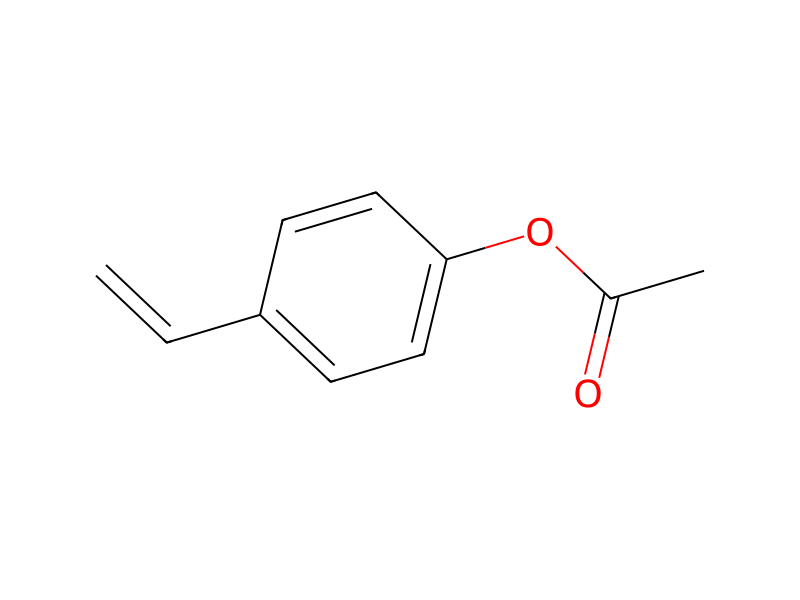
C([O:4][C:5]1[CH:12]=[CH:11][C:8]([CH:9]=[CH2:10])=[CH:7][CH:6]=1)(=O)C.[OH-].[K+]>O>[OH:4][C:5]1[CH:12]=[CH:11][C:8]([CH:9]=[CH2:10])=[CH:7][CH:6]=1Participants
Reactant 2

Product 1
Reagents, catalysts & solvents 1

Procedure
p-Hydroxyacetophenone was converted to 1-(p-acetoxyphenyl)ethanol and then dehydrated using liquid phase dehydration in the presence of potassium acid sulfate to produce p-acetoxystyrene, according to the method of Corson et al (J. Org. Chem., 1958 23, 544). p-Acetoxystyrene (1.6 g) was added to a stirred solution of potassium hydroxide (1.4 g) in water (14 ml) at 5 degrees Centigrade. Stirring was continued at 0-5 degrees Centigrade for 2 h. The mixture was then washed with ether, and the aqueous phase neutralised with saturated sodium hydrogen carbonate solution. The product was extracted into dichloromethane, the solution was dried over anhydrous calcium chloride and the solvent removed, to yield a cloudy oil (0.7 g) which solidified on standing to a waxy solid.
Workup
- washThe mixture was then washed with ether
- extractionThe product was extracted into dichloromethane
- dry with materialthe solution was dried over anhydrous calcium chloride
- customthe solvent removed
Sources & evidence
- ORD record
- ord-1bccda7236464bf2b53834ae31b31ad3
- Source dataset
- uspto-grants-1997_12
- Patent number
- US05693477
Reaction notes
Loading…