D-Tartaric acid → 2beta-hydroxymethyl-3beta-(4-iodophenyl)-tropane-D-Tartrate
Reaction equation

[OH:1][CH2:2][C@H:3]1[C@@H:9]([C:10]2[CH:15]=[CH:14][C:13]([I:16])=[CH:12][CH:11]=2)[CH2:8][C@H:7]2[N:17]([CH3:18])[C@@H:4]1[CH2:5][CH2:6]2.[C:19]([OH:28])(=[O:27])[C@H:20]([C@@H:22]([C:24]([OH:26])=[O:25])[OH:23])[OH:21]>CO>[C:24]([C@H:22]([C@@H:20]([C:19]([OH:28])=[O:27])[OH:21])[OH:23])([OH:26])=[O:25].[OH:1][CH2:2][C@H:3]1[C@@H:9]([C:10]2[CH:11]=[CH:12][C:13]([I:16])=[CH:14][CH:15]=2)[CH2:8][C@H:7]2[N:17]([CH3:18])[C@@H:4]1[CH2:5][CH2:6]2Participants
Reactant 2
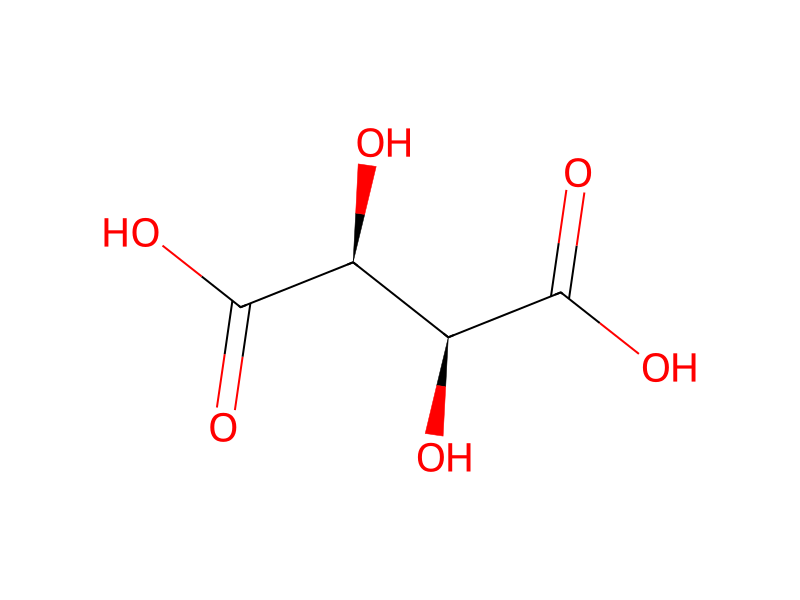

Product 1

Reagents, catalysts & solvents 1

Procedure
As shown in FIG. 1, 5 mmol 3β-(4-iodophenyl)-2β-(carbomethoxy)tropane (β-CIT (1)) is dissolved in 25 ml ethyl ether at 0° C., and 2 equivalents of lithium borohydride (LiBH4) are added. The temperature is raised to room temperature, and stirring is continued for approximately 2 hr. The reaction is quenched with water and the aqueous phase of the mixture is extracted with methylene chloride. The organic phase is collected and dried over magnesium sulfate and the solvent is removed to give 2β-hydroxymethyl-3β-(4-iodophenyl) tropane free base (2) in quantitative yield. 2β-hydroxymethyl-3β-(4-iodophenyl)tropane was fully characterized as D-tartaric acid: mp=90°-92° C., [α]D20 -66.3° C. (c, 0.525, MeOH). 1H NMR (250 MHz, CDCl3): δ 7.59 (d, J=8.4 Hz, 2H); 6.99 (d, J=8.4 Hz, 2H); 3.76 (dd, J=11.06 Hz; 1H); 3.44 (d, J=4.59 Hz, 1H); 3.32 (m, 2H); 3.01 (m, 1H); 2.47 (td; J=2.88 Hz, J=12.74 Hz; 1H); 2.20 (s, 3H); 2.16 (m, 2H); 1.70 (m, 2H); 1.65 (m, 1H), 1.46 (m, 1H). Anal. (C15H20 NO1) (C4H6O6): CHN.
Sources & evidence
- ORD record
- ord-a2495b052c014131971f7cd12b0a6843
- Source dataset
- uspto-grants-1997_12
- Patent number
- US05700446
Reaction notes
Loading…