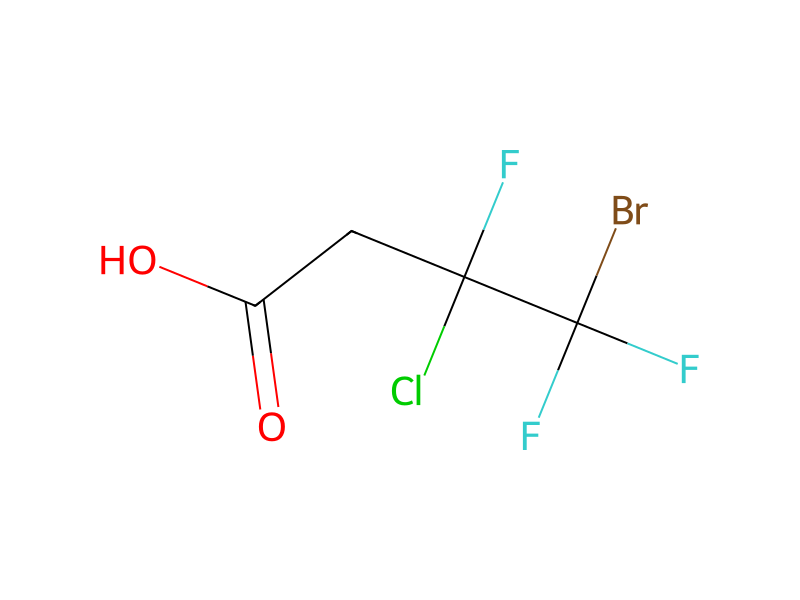
Vinylidene chloride → 4-Bromo-3-chloro-3,4,4-trifluorobutanoic acid
Reaction equation

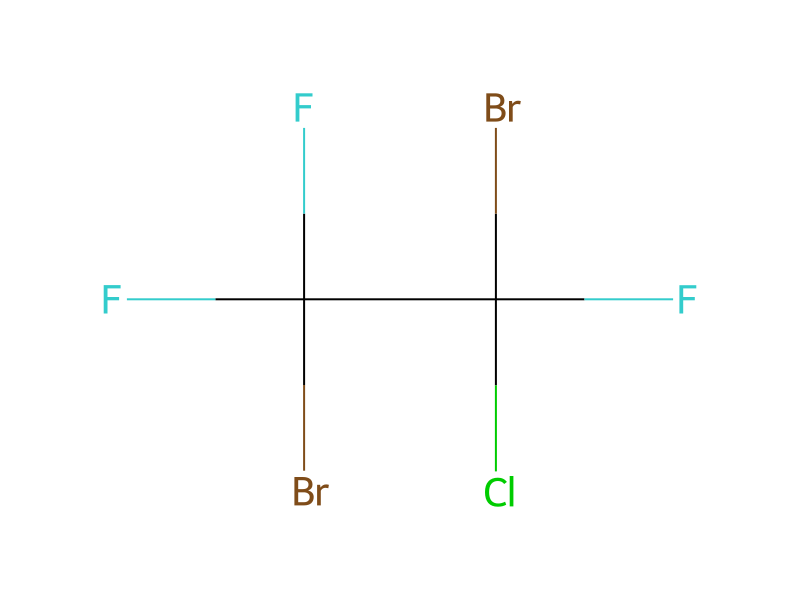
FC(=C(F)F)[CH2:3][C:4]([OH:6])=[O:5].[Cl:10][C:11]([F:17])(Br)[C:12]([F:15])([F:14])[Br:13].C(Cl)([Cl:20])=C.S(OOS([O-])(=O)=O)([O-])(=O)=O.[NH4+].[NH4+].C([O-])=O.[Na+]>CN(C=O)C.ClC(F)(Cl)C(F)(F)Cl>[Br:13][C:12]([F:15])([F:14])[C:11]([Cl:10])([F:17])[CH2:3][C:4]([OH:6])=[O:5].[Cl:10][C:11]([F:17])([C:12]([Cl:20])([F:15])[F:14])[CH2:3][C:4]([OH:6])=[O:5]Participants
Reactant 4

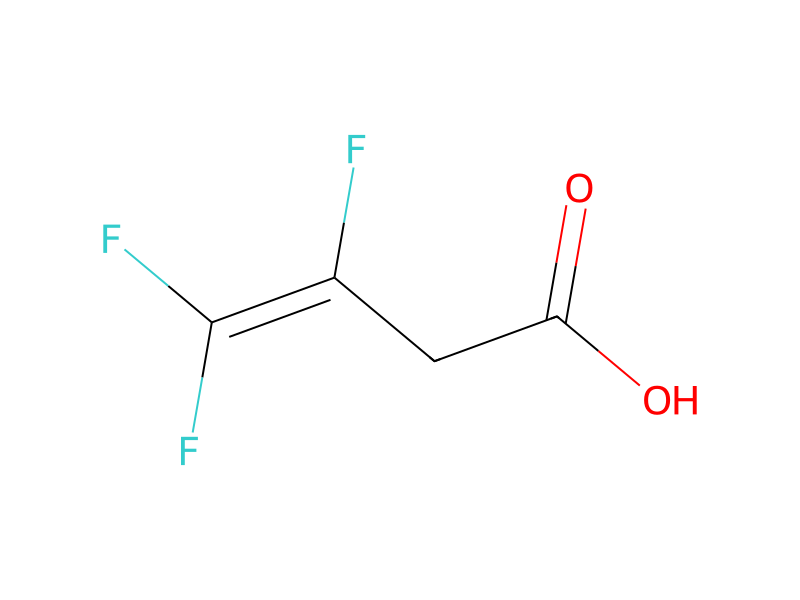

Product 2

Reagents, catalysts & solvents 2


Procedure
A new method to prepare the desired 3,4,4-trifluoro-3-butenoic acid (IV) involves a one pot reaction of 1-chloro-1,2-dibromotrifluoroethane (VI) or 1,1,2-trichlorotrifluoroethane (X) with vinylidene chloride in the presence of ammonium persulfate/sodium formate/air in DMF to give directly 4-bromo-3-chloro-3,4,4-trifluorobutanoic acid (VIII) or novel compound 3,4-dichloro-3,4,4-trifluoro-butanoic acid (XI). The reaction conditions to prepare XI from X are similar to those described in Hu, Chang-Ming; Qing, Feng-Ling; Zhang, Hong-Gen; J. Fluorine Chem., 1990, (49) 275-280. The information of XI in the above reaction was confirmed by GC/MS (EI): m/z 212 (M+ +2), 210 (M+), 195, 193, 157, 155, 127, 125, 107, 105, 89, 69, 45. Dehalogenation of VIII or XI with zinc gives IV. ##STR5## The compounds of formula XVII can also be prepared by an alternate method to prepare selected compounds of formula I as exemplified with XV shown in Scheme 4. The reaction sequence shown in Scheme 4 using novel intermediate XII and XIII exemplified by XIV can also be carried out by substituting XI in place of VIII to prepare compounds of formula XVII. ##STR6##
Sources & evidence
- ORD record
- ord-03734b545f4747dc9453d533c8c295b8
- Source dataset
- uspto-grants-1997_12
- Patent number
- US05700840
Reaction notes
Loading…