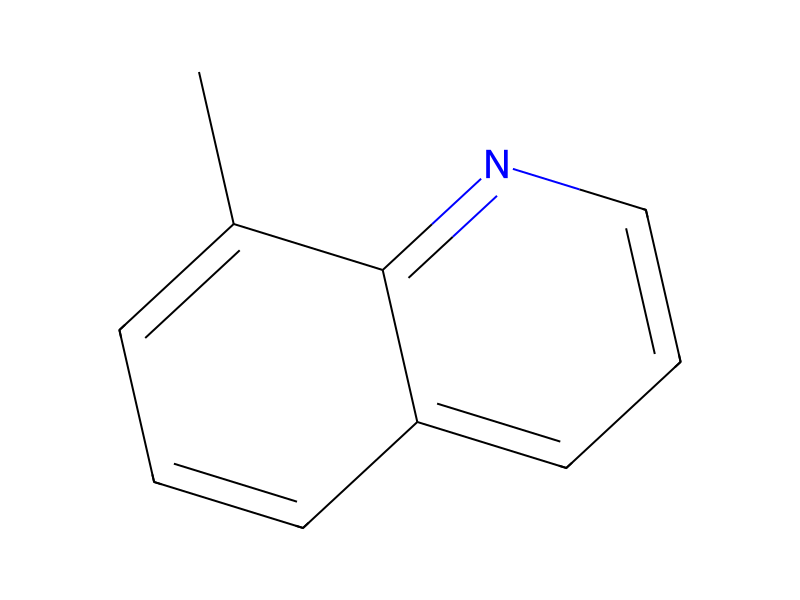
8-Methylquinoline → O-Toluidine
Reaction equation

[CH:1](=[O:3])[CH3:2].[NH2:4][C:5]1[C:6]([CH3:11])=[CH:7][CH:8]=[CH:9][CH:10]=1.[CH3:12][C:13]1[CH:14]=[CH:15][CH:16]=[C:17]2[C:22]=1[N:21]=[CH:20][CH:19]=[CH:18]2>>[CH:1](=[O:3])[CH3:2].[NH2:4][C:5]1[C:6]([CH3:11])=[CH:7][CH:8]=[CH:9][CH:10]=1.[NH2:21][C:22]1[C:13]([CH3:12])=[CH:14][CH:15]=[CH:16][CH:17]=1.[CH3:10][C:9]1[CH:8]=[CH:7][CH:6]=[C:2]2[C:1]=1[N:21]=[CH:20][CH:19]=[CH:18]2Participants
5


Procedure
The data in Table 2 demonstrate that increasing acetaldehyde/ortho-toluidine molar ratios benefit the 8-methylquinoline selectivity, yield and productivity. In addition, acetaldehyde/ortho-toluidine molar ratios of ≥2 gave very high conversion of ortho-toluidine and improved 8-methylquinoline product purity as shown by the 8-methylquinoline/2,8-Me2Q weight ratio. The 2,8-Me2Q (b.pt.=255° C.) is the primary impurity which needs to be minimized upon distillation of the 8-methylquinoline (b.pt=248° C.).
Workup
- customyield
Sources & evidence
- ORD record
- ord-de6dd92574d14ef0bc50bfe8963b7bea
- Source dataset
- uspto-grants-1997_12
- Patent number
- US05700942
Reaction notes
Loading…